

The hottest take in tech right now:
“AI killed junior programmers.”
The narrative goes like this: since AI launched, junior developer hiring has collapsed, which proves AI is already replacing entry-level workers.
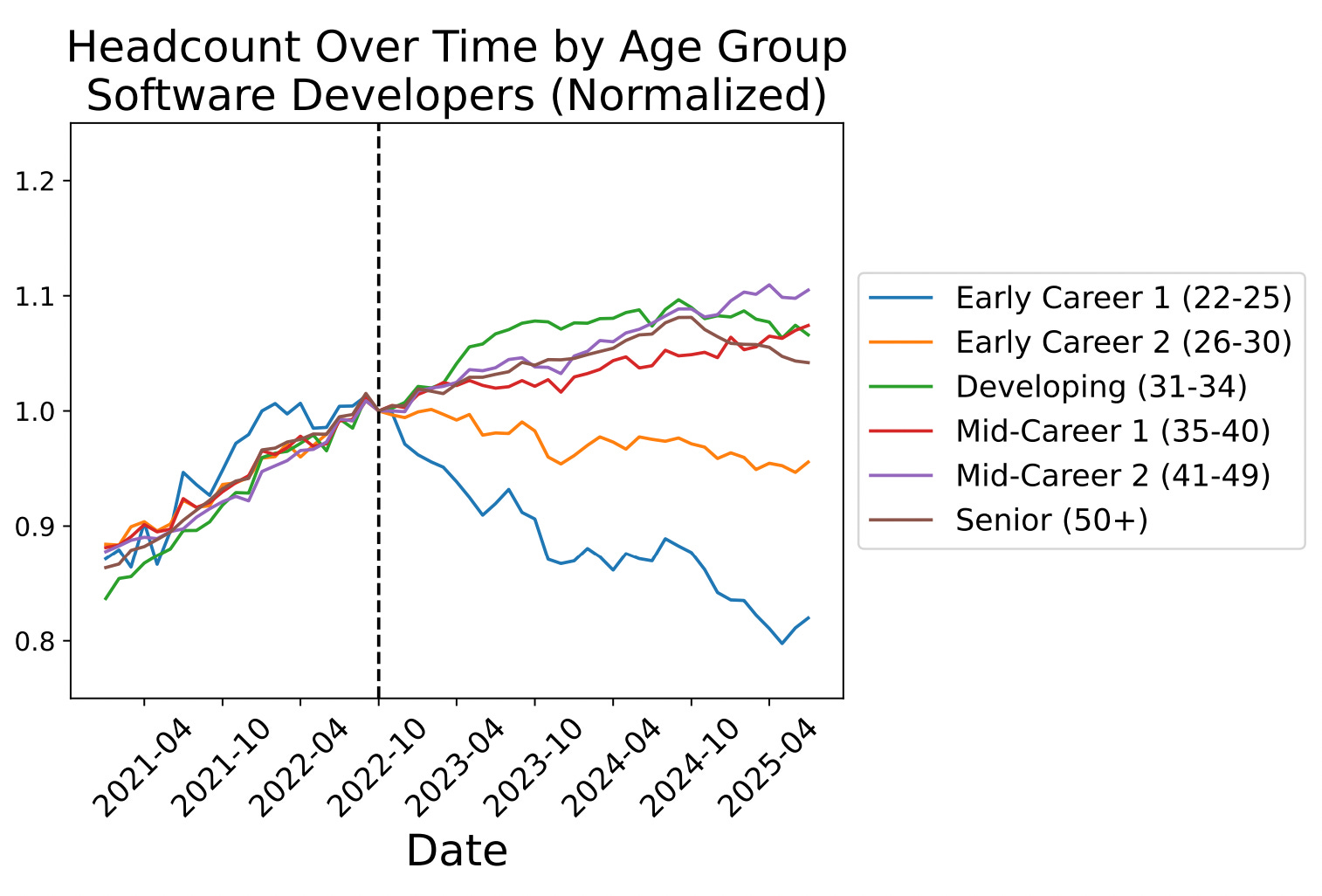
The recent Stanford Digital Economy Lab paper using ADP payroll data fits this narrative like a glove. The graphs show AI-exposed occupations seeing a sharp decline in hiring for 22–25 year olds, while mid-career and above remained stable.
It reads like a clean, satisfying confirmation of everyone’s worst fears. The timing is almost too perfect. And that’s exactly what made me suspicious — this felt like a paper designed to tell people what they already wanted to hear, optimized for attention rather than rigor. Predictably, the media ran with the working paper without any verification, chasing clicks. Self-proclaimed “AI experts” flooded feeds with grave-faced posts about the future of humanity.
So I read the whole thing carefully. My conclusion: it’s an interesting but deeply flawed working paper that hasn’t even been peer-reviewed yet, with significant gaps in data and logic. Here’s my breakdown.
Full disclosure — I wrote a similar prediction in a previous newsletter, so I could easily just say “You saw it. I called it. Stanford agrees.” But wrong is wrong, and my personality won’t let me coast on a convenient narrative. So: “Long-term, yes, this is coming. But not yet. Can everyone please calm down?”
It’s the Economy, Stupid

Before we dissect the Stanford paper, let’s look at the actual U.S. labor market numbers.
According to the Bureau of Labor Statistics:
2023 non-farm payrolls: +251,000/month average.
2024 initially reported: +147,000/month average.
2024 actual (after benchmark revision, April 2024–March 2025): +71,000/month — less than half of what was reported.
August 2025: just +22,000.
June was revised to -13,000.
The U.S. labor market has been far worse than anyone realized. This isn’t an “AI replacing juniors” pattern — it’s a textbook economic slowdown.
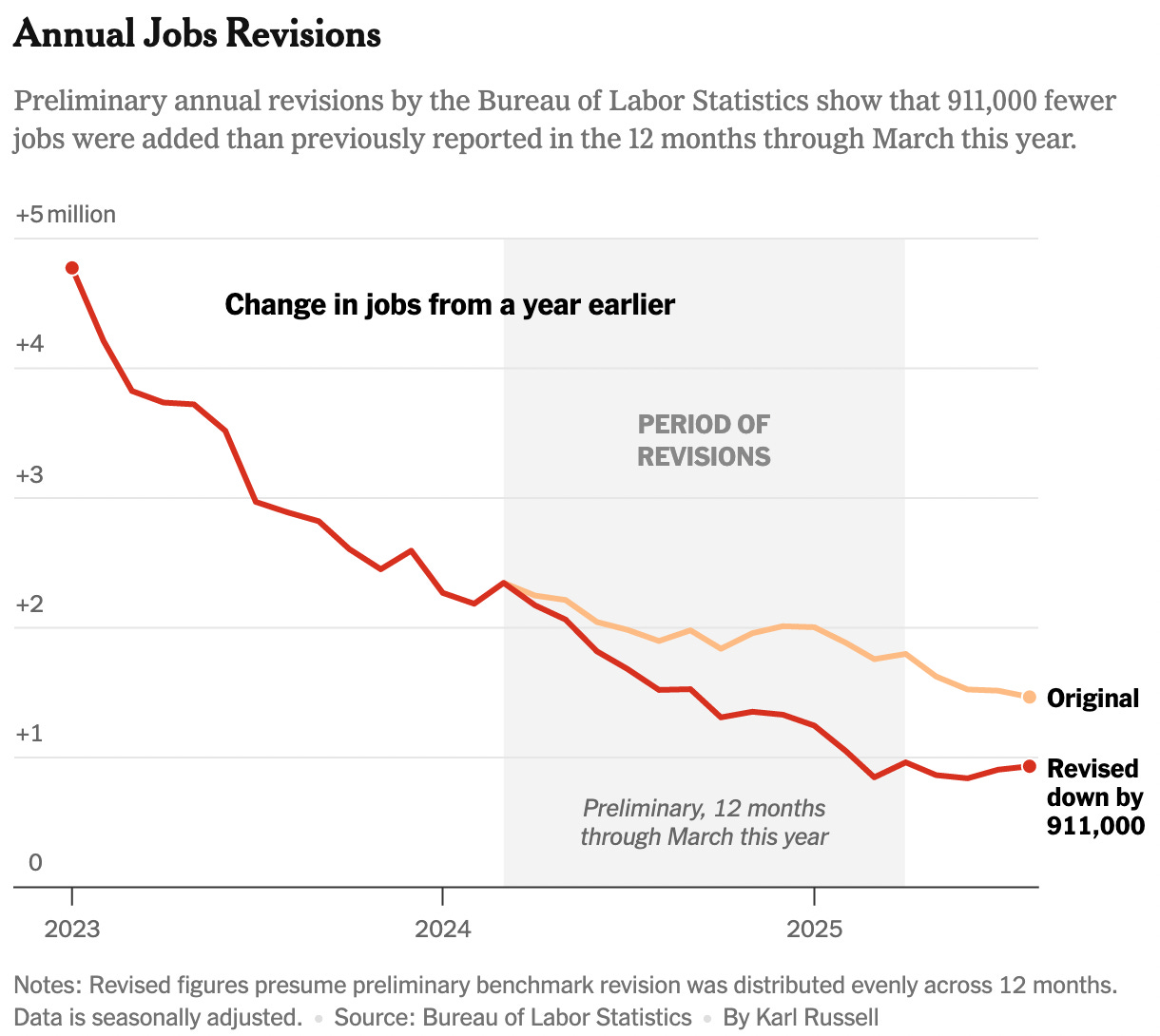
And here’s the thing everyone in economics already knows: downturns always hit the weakest link first — new graduates and junior workers. What we’re seeing in junior hiring isn’t AI suddenly devouring human jobs. It’s the historically recurring pattern of economic cycles, where junior workers get squeezed out first. AI is certainly an interesting variable, but juniors getting hit hardest in a downturn is literally in the econ textbook.
The Stanford-ADP Paper: Interesting, but Wildly Overinterpreted
Let me be specific about what this working paper shows:
AI-exposed occupations saw –6% decline in 22–25 year old employment, with some roles down –20%.
The same occupations saw +6–9% increases for workers 30 and above.
On the surface, it perfectly supports the “AI replaced juniors” narrative. But several critical questions emerge.
ADP Data Representativeness
About 1 in 6 U.S. workers get paid through ADP — a decent sample, but not overwhelming. The bigger issue: ADP’s client base skews heavily toward small and mid-size businesses (at least 65%). This means the employment trends captured in ADP data are structurally more sensitive to SMB economic cycles.
During periods of rising interest rates and tightening capital, mid-size companies are the first to freeze new hiring and cut junior/software/customer-facing roles. Meanwhile, big tech and large enterprises — the ones actually adopting AI most aggressively — typically use their own HR systems and don’t show up in ADP data at all.
See the problem? The companies most likely to replace workers with AI are barely represented in this dataset. The companies in this dataset are the ones most likely to cut juniors for plain old economic reasons.
Oversimplified Categories
Lumping software developers and customer service reps into the same “AI-exposed” category is a serious oversimplification. Even Klarna — the poster child for AI replacing customer service — had to rehire human agents after customers revolted over plummeting service quality.
Timing Doesn’t Add Up
The paper claims junior hiring started declining from late 2022, attributing it to AI. But think about the timeline: are we really supposed to believe that mid-size companies adopted ChatGPT the moment it launched and immediately started cutting junior headcount? Let’s all collectively remember what we were actually doing with AI in 2023. It was a novelty, not an enterprise deployment.
Other Gaps
ADP data shows aggregate employment trends but can’t distinguish between hiring freezes and layoffs. Labor economics has long established that companies in downturns freeze hiring before they fire — meaning the junior decline likely represents closed doors, not replaced workers.
Most critically: wages haven’t dropped significantly. If AI were genuinely replacing workers at scale, the first observable effect would be wage compression in affected roles — supply of replaceable labor exceeds demand, pushing wages down. That hasn’t happened. This alone makes the “economic slowdown” explanation far more persuasive than the “AI takeover” explanation.
The working paper found correlation. It did not prove causation.
Companies Haven’t Even Figured Out AI Adoption Yet
Let’s look at where enterprises actually stand:
BCG (2024): 74% of companies globally have failed to generate real value from AI or scale it successfully.
MIT NANDA (2025): 95% of GenAI pilots showed no ROI. (Though I’ll admit this report also feels somewhat exaggerated.)
US Census (2025): Large enterprise AI adoption actually dropped from 14% to 12%.
AI isn’t in the replacement phase. It’s still stumbling through the pilot phase, burning money along the way.
And mid-size companies — the ones dominating ADP’s data — are even further behind:
RSM Middle Market AI Survey (2025): 91% of mid-size firms say they use generative AI, but only 25% have fully integrated it into operations. Knowing how companies love to overstate adoption in surveys, if this is where things stand in 2025, we’re nowhere near junior replacement levels.
TXI Report (2025): Mid-size companies have big AI ambitions but remain stuck in exploration/pilot phases due to data infrastructure gaps and talent shortages.
OECD Report (2025): Large enterprises adopt multiple AI technologies simultaneously; mid-size firms are limited to single-technology, narrow implementations.
Andersen Institute (2025): AI adoption is most active at startups and large enterprises. Mid-size firms lag due to change management and cost barriers.
The conclusion: mid-size companies are active in AI pilots but structurally delayed in enterprise-wide execution. This further supports the interpretation that junior hiring declines in ADP data reflect economic slowdown and post-pandemic hiring corrections — not AI replacement.
So What?
“AI killed junior programmers” is a provocative headline and excellent engagement bait — I’ll give it that. But what’s actually happening is the impact of economic slowdown, the hangover from COVID-era over-hiring, and companies using AI as a convenient excuse for margin management.
The data shows a classic labor market weakening pattern consistent with recession.
The software industry massively over-hired during the pandemic, and we’re watching the correction.
Mid-size companies — let alone large enterprises — haven’t successfully deployed AI yet, and ROI is essentially zero.
ADP data is structurally skewed toward SMBs, making it dangerous to generalize across the entire tech/industry landscape.
The Stanford-ADP study found correlation but failed to prove causation.
This working paper is getting massive media coverage, but in terms of academic rigor, it’s still at the “preliminary interpretation” stage. It’s not from a Stanford core department, and it hasn’t been peer-reviewed. The data may have captured an interesting signal, but jumping straight to “AI killed juniors” is dangerous overinterpretation.
That said — AI has genuinely boosted productivity. I feel it every day in my own work. But it hasn’t reached the level of replacing juniors yet. Companies are struggling to even implement AI properly, hemorrhaging money in pilot phases. The current trend is companies using AI as a scapegoat to cover for recession-driven hiring freezes and failed hiring strategies.
Crisis Is Opportunity
None of this means juniors aren’t facing a crisis. They are — and I believe the full impact of AI on junior roles is coming eventually. But the important thing to recognize is that this crisis could also become the soil and fuel for building the next generation of great companies.
As I wrote before, integrating AI into existing systems structurally favors senior experts — they’re the ones with the experience and knowledge to verify and leverage AI’s outputs. But simultaneously, this is the best era in history to create something entirely new.
Rather than fitting AI into existing systems, the bigger opportunity for juniors — who lack deep experience in legacy frameworks — is building AI-native businesses and services from scratch. Their lack of institutional baggage is actually an advantage: through first principles thinking, they can generate fresher, bolder ideas that overturn existing paradigms and create entirely new markets. AI has opened that door.
AI is simultaneously a massive threat and an unprecedented opportunity for juniors. The key is not fearing the change but leaning into it aggressively, exploring new possibilities. It’s cliché, but “crisis is opportunity” fits perfectly right now.
To the talented juniors reading this: don’t let this moment pass you by. If you’re ready, or even just curious, reach out anytime at ian@ianpark.vc. (Fair warning — I’m building from the ground up myself these days, so replies might be slow. Bear with me.)
Thanks for reading, as always.
— Ian