

I Sat the World’s Top 20 VCs on an Investment Committee in 30 Minutes. So Is Venture Capital Dead?
Plus: A free prompt so your pitch deck can face the world’s best investors

It took 30 minutes. I asked Claude to build a system where 20 real VC personas — each with their own distinct investment philosophy — independently evaluate a pitch deck, then the top 3 sit down for a 5-round investment committee debate. And it just... worked. Polishing the design and generating five sample reports took a bit longer, but the core build? Thirty minutes.
It started simply enough. An anonymous associate in our KakaoTalk group built a web app that uses AI to analyze pitch decks and wanted feedback. They were planning to sell it to startups as a paid service, which I thought was a solid idea. But my mind went somewhere different: instead of charging startups, what if I used something like this as a personal tool — a way to go deeper on the decks that land in my inbox?
So I sent Claude the screenshots, told it to replicate the functionality, and what came back was more than sufficient for what I needed.
For anyone who wants to try it themselves, I’ve published the full prompt on the website. Run it on Claude, ChatGPT, whatever you prefer. I’ve also added a direct link to pitch me your deck — we’re about to start sourcing pre-seed deals more aggressively (official announcement next week).
→ [AIVC Reports, Prompts, and Pitch Your Deck]
The results were more surprising — and more fun — than I expected.
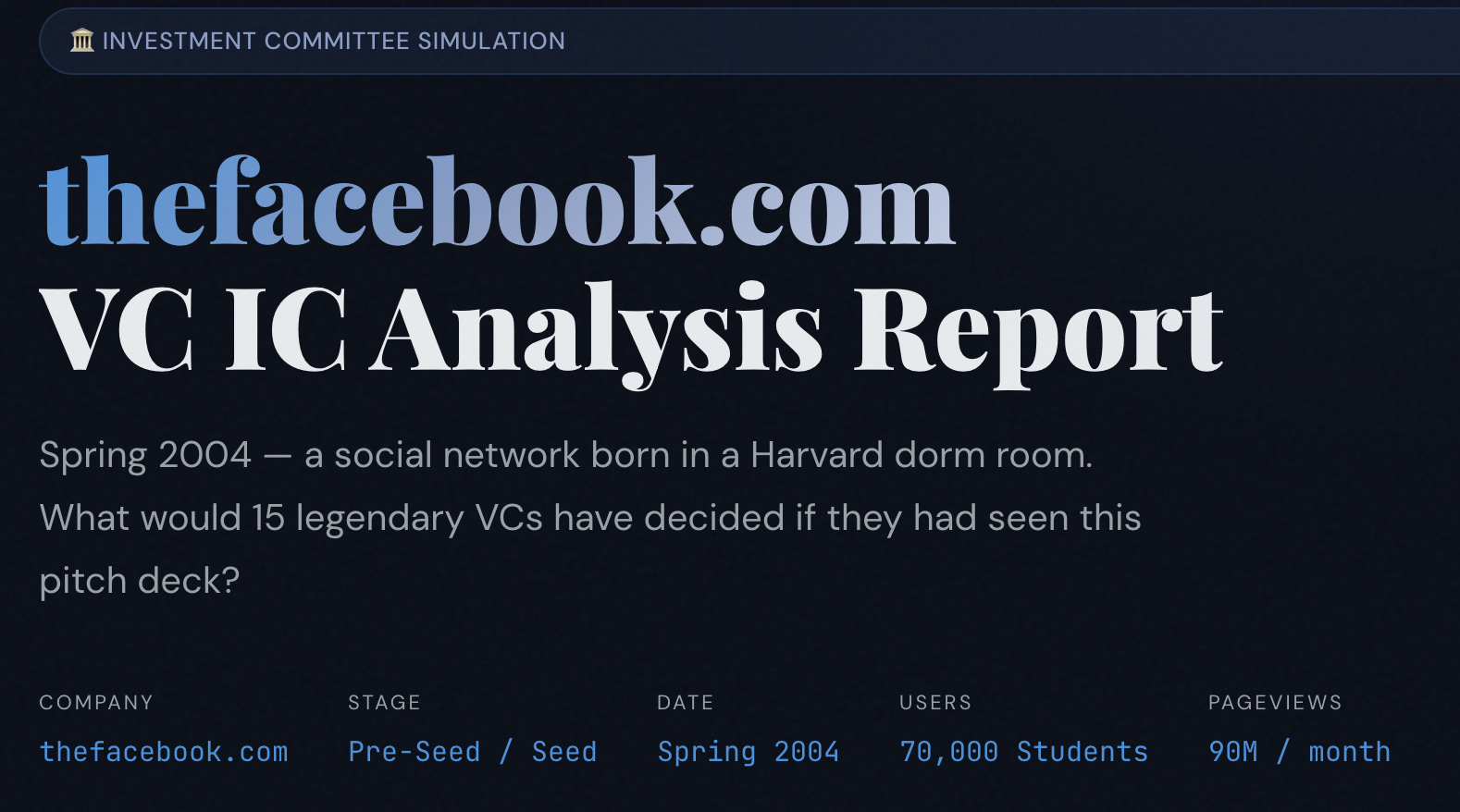
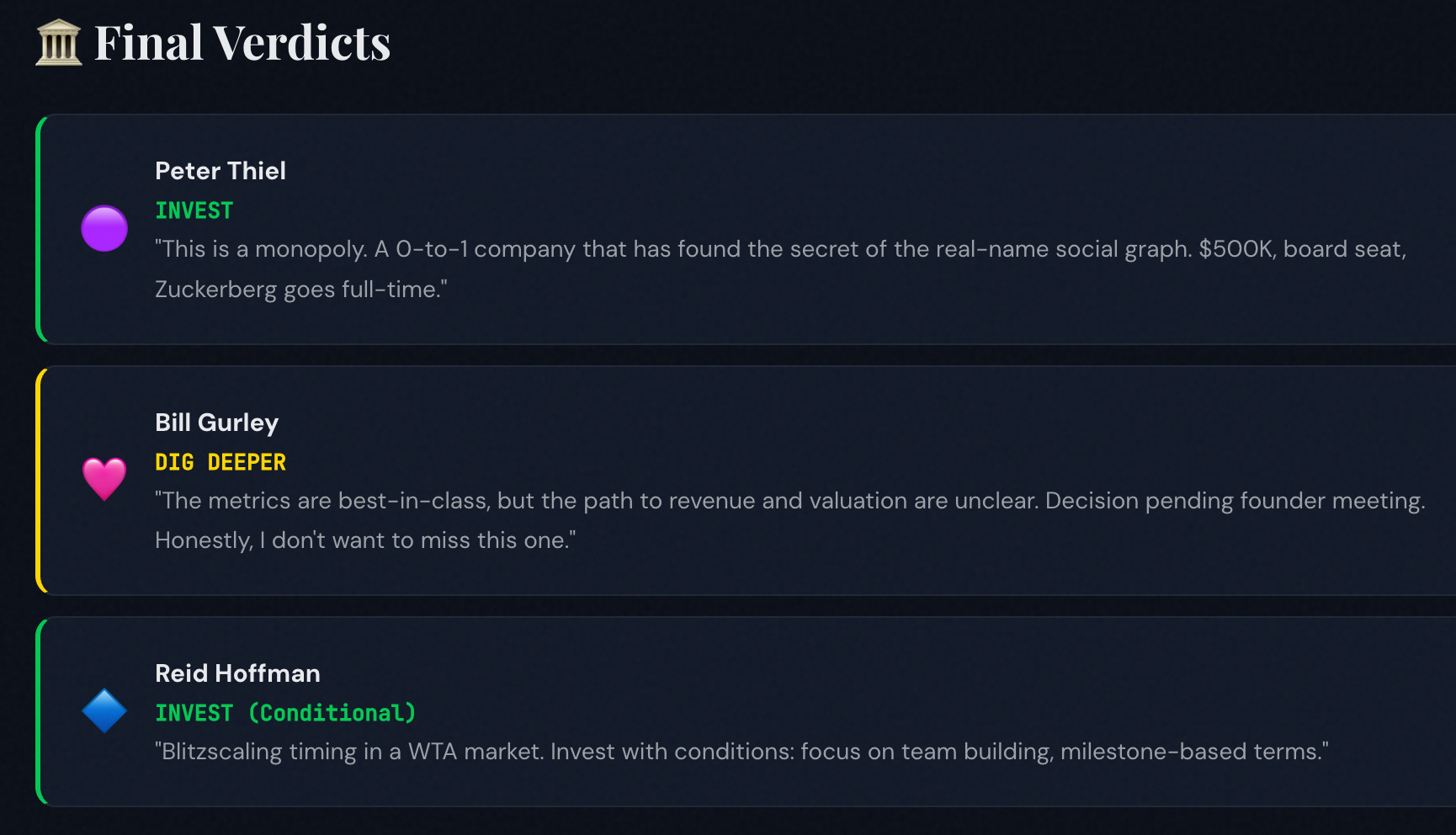
I fed it thefacebook’s 2004 pitch deck. 9 out of 10 voted Invest. Zero passes. Near-unanimous. And yes, AI-Peter Thiel made the same call real Peter Thiel did.
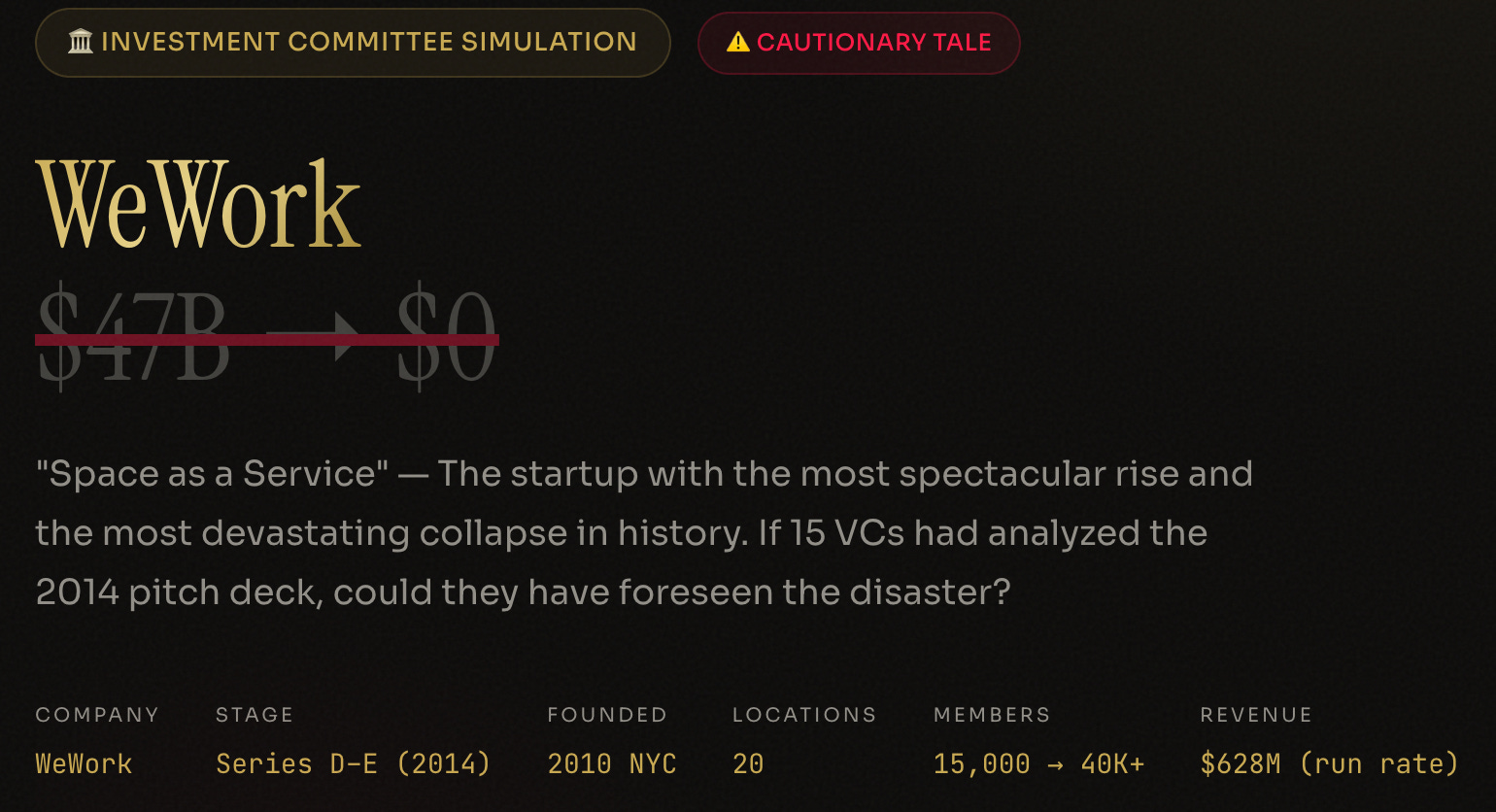
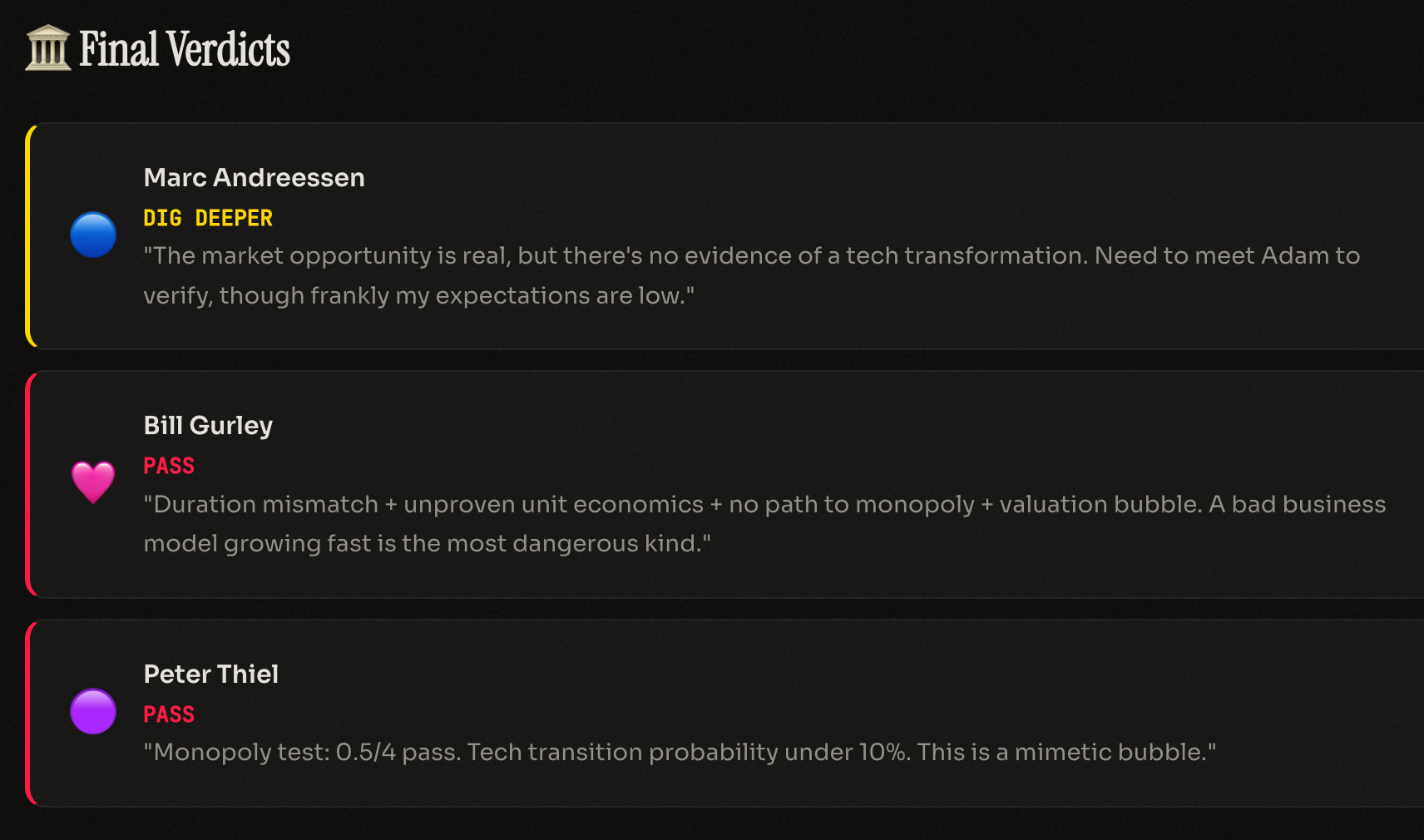
Then I ran WeWork’s 2012 deck. 3 out of 10 voted Pass. The AI raised red flags. In reality? Masa Son committed $4.4 billion after a 12-minute meeting. (Maybe I should add Masa to the persona list and re-run it... )
I also tested Airbnb, Uber, and YouTube. The AI predicted outcomes reasonably well and surfaced genuinely interesting analysis. But here’s the thing — in every case, the actual investment was made by a human.
So can AI replace VCs?
The Question Itself Is Wrong
“Will AI replace VCs?” is the wrong question. It’s not a binary. The right question is: “Where exactly is the boundary between what AI can replace in venture investing and what it can’t?”
And that boundary isn’t defined by AI’s capabilities or some fancy system architecture.
It’s defined by the presence — or absence — of data.
From Public Markets to Venture: The Data Disappears
My entire career has been a journey from data-rich to data-poor environments. Math and economics undergrad, an economics PhD attempt (spectacular failure), an applied CS master’s — I wrestled with numbers for years. Then consulting → PE → VC → LP (reviewing VCs) → back to VC. Each step took me further from the world of abundant data into territory where numbers barely exist.
What drove each transition was a growing conviction: no matter how meticulously you analyze the numbers, it always comes down to people. I distinctly remember thinking, “An AI is going to automate this Excel work any day now.” That anxiety pushed me toward the parts of investing where humans still matter most.
And now that exact thing I worried about is actually happening.
So let’s map the investment world by data density:
Public equities — Real-time prices, financial statements, trading volumes, analyst reports. Everything is a number. Quants and algorithms already beat most humans here. (Though almost no quant fund has outperformed index funds over 15+ years, but that’s another story.)
Private equity — Satellite imagery counts cars in Walmart parking lots. AI analyzes ships docked at ports. Firms buy Whole Foods receipt data through loyalty point schemes. Quantification is advancing on all fronts, and now that LBO modeling is getting automated through Claude, AI’s territory expands daily.
Late-stage venture — Revenue, MRR, churn rates, CAC/LTV — real metrics exist. AI handles first-pass filtering and benchmark comparisons just fine.
Early-stage venture — No revenue. No users. The market itself might not exist yet. All you have is one human being called “a founder.” This is the domain of insight, reasoning, imagination — not spreadsheets.
The further you move from public markets toward early-stage venture, the more data evaporates. And AI without data is powerless.
AI doesn’t fail to replace VCs because AI isn’t good enough. It fails because the things that matter most in early-stage investing haven’t become data yet.
The Things That Never Make It Into a Database
I’ll share one story about why people matter most — and I generally avoid writing publicly about specific founders (unless they’re celebrities like Sam Altman), because I think it’s poor form. But this one stuck with me.
There was a founder who gave me a bad feeling. Not a smoking gun — just a collection of circumstantial signals that didn’t add up. My exact words at the time: “There’s smoke coming from everywhere, but I can’t find the fire.” (I should have remembered the old saying: where there’s smoke, there’s fire.)
The company’s growth numbers were strong, and the lead partner pushed hard. Most of the IC went along. But one partner dissented with a line I’ve never forgotten:
“Life is too short to work with people like this guy.”
We overruled that partner. The founder eventually imploded. The fund took a significant loss.
This wasn’t an isolated incident. I’ve watched company after company with picture-perfect metrics collapse — from bad luck, geopolitics, macroeconomic shifts, new technology, or founder mistakes. Each time, my conviction grew stronger: what matters isn’t today’s numbers, but whether a founder can survive whatever comes next.
Meeting people face-to-face. Extracting the information hidden behind the numbers that only you can access. That, I’ve come to believe, is the essence of venture capital.
I’ve said it many times: in early-stage investing, the founder is everything. Are they more obsessed with the problem than I am? Smarter about the solution than I am? More persuasive about their vision than I am? Would I want to work for this person? If they fail this time, would I back them again? None of this shows up in a spreadsheet. It’s not in any database. The only way to know is to sit across the table and talk.
To be clear — AI is excellent as a first filter. It structures the intuitions partners already have, catches blind spots, asks sharp questions. For pre-meeting research, it’s outstanding.
But the final call, and the accountability that comes with it, still belongs to humans.
Three Things That Will Change
None of this means VC stays the same. AI won’t replace VCs, but it will absolutely reshape the landscape.
First, the junior VC crisis. The traditional research-analyst junior role is dying. Big-picture research has been leveled up across the board. The tool I built in 30 minutes is proof. Market sizing, competitive analysis, benchmark comparisons — work that used to take a junior two days, AI now handles (imperfectly) in half an hour. What juniors need going forward isn’t basic research skills. It’s the ability to verify research quality and accuracy, the ability to build direct relationships with founders, operator experience in specific verticals, generational instincts that partners lack. Without an edge beyond research, survival gets hard.
Second, the rise of non-traditional VCs. As the research barrier to entry collapses, the intellectual capital that traditional VCs hoarded becomes commoditized. Knowing “how big is this market” used to be a competitive advantage. Now anyone can find out. Paradoxically, this creates opportunity. VCs with communities sense market needs first. Domain-expert VCs always have their research done. VCs with media platforms have founders coming to them. You don’t need a finance or founder background anymore — if you have your own unique leverage, this might be the best time ever to start a fund. Conversely, finance-background VCs who relied purely on market research to evaluate deals will be the first to struggle.
Third, it’s no longer about what you know — it’s about how you see. The VCs who get stronger from here are those who compete on perspective and insight, not volume of information. Insight isn’t something you Google. It lives inside people who’ve internalized it over years. As AI levels the research playing field, the axis of differentiation shifts from “what do you know” to “how do you see it.” Same with networks. It’s not “who do you know” — it’s “who have you made money with?” The strongest networks are forged between people who’ve succeeded and failed together. Not LinkedIn connection counts.
So What?
The democratization of research will actually make insight more visible, not less.
Howard Marks compared investment insight to height in basketball — you’re either born with it or you’re not. Annoying, but there’s some truth to it. Some people genuinely see what others miss.
But I think insight is closer to muscle than height. Height is genetic. Muscle is built.
In basketball, being tall helps. But height alone doesn’t get you to the NBA. Shooting form, court vision, defensive positioning — all built through thousands of hours of repetition. Steph Curry isn’t the tallest player in the league. But tens of thousands of practice shots created the muscle memory that made him the greatest shooter ever.
Investment insight works the same way. Constantly studying, agonizing over your own thesis, sitting through hundreds of pitch meetings, surviving dozens of failed investments, living through market reversals in your bones — this is how “this will work” and “this won’t” becomes instinct that sticks to you like muscle. Not in one or two years. Five years. Ten years. And it requires innate curiosity, the personality to go deep, and an environment that sustains it. You can’t just grind your way there.
Until now, this difference was hard to see. Do enough research, delegate to interns, pile up materials, and you could produce a convincing-enough investment memo. Time investment papered over the gap.
Now AI handles that part.
With basic research and information gathering democratized, the real capability gap — previously hidden behind sheer hours of work — becomes nakedly obvious. AI gives everyone height. More data, wider vision, faster analysis. But it can’t build the muscle for you.
Will IC partners trust a VC who shows up with a generic, AI-generated investment memo and no original thesis? Will LPs allocate capital to that person?
The gap between VCs who genuinely love this work and have spent years sharpening their own perspective, and those who’ve been investing by consensus and following the crowd — that gap becomes more visible than ever.
And that is exactly why VCs that can’t be replicated in 30 minutes will continue to exist.
Could AI Eventually Replace VCs?
Will there come a day when conversational nuance, a founder’s aura, the chemistry between people — all of it becomes data? I think it’s either very far off or permanently impossible. But if that day comes, then yes, AI could replace VCs too. But that would mean we’ve quantified human beings.
An AI that quantifies and judges people. Is that even possible?
And if it is — is that a world we actually want?
Thanks for reading, as always.
Ian