

The Real Reason Microsoft Should Worry (Hint: It’s Not AI Spending)
Watching Microsoft’s stock crater today reminded me of something I talked about with my VC friends a few days ago. Let me be clear: I have zero talent for predicting stock movements. (If I could, I’d be trading, not writing newsletters.) But having built my entire career in finance—where Excel is basically scripture—I’ve been thinking about what happens when AI finally conquers the spreadsheet.
The Headlines vs. The Real Story
The official narrative for today’s drop:
Astronomical AI spending with nothing to show for it.
Margin collapse—profit margins fell from 72% to 67% over the last five quarters.
Azure deceleration—cloud growth disappointing.
All valid concerns. But I think the real existential threat is something else entirely.
The collapse of Excel’s moat.
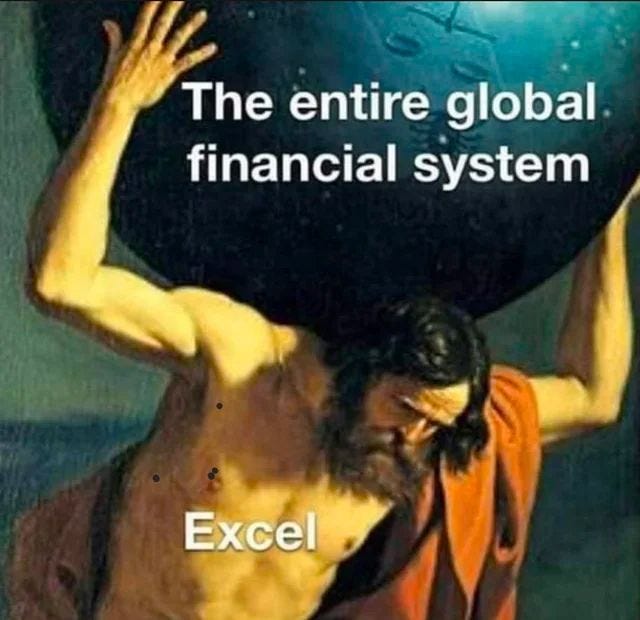
The Liberation of the “Shortcut Slaves”
Here’s something non-finance people don’t understand: The reason finance stayed married to Excel—and by extension, Windows—was never about performance. It was about muscle memory.
Decades of keyboard shortcuts, burned into the fingers of every banker and analyst. Windows Excel shortcuts are completely different from Mac Excel. Google Sheets, being browser-based, could never replicate the feel because of shortcut conflicts. This “familiarity” was Microsoft’s most powerful weapon for 30 years.
Then Claude in Excel happened.
The moment AI can write formulas and understand data flows, that “no-mouse, keyboard-only” flex that finance bros have bragged about for decades becomes a relic. Thirty years of accumulated shortcut mastery? Worthless overnight.
Google’s Counterstrike: When Skill Barriers Disappear
When tool proficiency stops being a competitive advantage, the entire game changes.
If the keyboard shortcut barrier vanishes, why use heavy, clunky Excel at all? A mass migration to Google Sheets—lighter, collaboration-native—becomes inevitable.
But here’s what’s scarier: distribution. Google can plug any AI model into its Workspace ecosystem instantly. What Claude can do today, Gemini will do tomorrow. As AI performance converges, the winner is whoever has better UX, easier access, and stronger alliances. Google has all three—plus that Apple partnership.
This isn’t just an Excel problem. It threatens the entire Windows OS and PC ecosystem.
The New Order: Google + Apple vs. Microsoft
Microsoft falls behind
Let’s be honest: Companies have stuck with Microsoft because of security concerns and bundling—not because the tools are actually good. (Hot take: None of Microsoft’s tools work particularly well.) If Excel—the crown jewel of that bundle—crumbles, the reason to stay disappears.
Security is more complicated. Many enterprises still distrust the cloud. But we’re approaching the tipping point where AI productivity gains outweigh security convenience.
Sure, companies with seasoned (read: change-resistant) CTOs will move slowly. But eventually everyone faces the “adopt or die” moment.
Using Microsoft won’t kill your company tomorrow. But when everyone else is doing 100 km/h with AI and you’re stuck at 10 km/h on legacy tools, getting left behind isn’t a possibility—it’s a certainty.
Google and Apple pull ahead
Hardware already tilted. Apple’s M-series chips deliver exactly what the AI era demands—performance, boot speed, battery life, longevity. Outside of gaming, the PC advantage keeps shrinking. And gaming? Steam Deck and the upcoming Steam Machine 2026 are chipping away at Windows’ last stronghold. Even in AR/VR, Microsoft is losing to Meta and Apple.
Google’s data and ecosystem plus Apple’s hardware dominance—if they start competing on price with their cash reserves? The AI era gets divided between Google (software) and Apple (hardware).
So What Does This Actually Mean?
The change won’t come from Microsoft shops suddenly switching. (Organizations that flexible probably already left.) It’ll come from Google-native companies dramatically outproducing Microsoft-native ones, growing faster, and eventually reshaping the market itself. Microsoft doesn’t collapse—it just gets relatively smaller as the Google + Apple camp grows disproportionately larger.
Could AI trigger not just the decline of B2B SaaS, but the decline of Windows OS itself?
I built my career on Excel. I was a devoted ThinkPad Carbon user, a true believer in the red TrackPoint nub. I only recently defected to the Apple ecosystem. So maybe I’m overreacting to this shift because it’s personal.
But even accounting for that bias—the fall of Microsoft Excel could shake the global financial system. It would be a historical event none of us forget.
Just something to think about.