

“This isn’t a story about Michigan’s failure. It’s a story about what America promised Michigan — and broke. And why that same promise is about to break for the rest of us.”
[Next Michigan: Part 1] The End of Work Isn’t Coming. But Your Job Might Be.
Technology Has Never Set Humans Free
Last week, I summoned the 20 greatest VCs in history in 30 minutes.
I built something called AI VC Reports — an investment committee simulation. Imagine the most legendary venture capitalists sitting around one table, tearing apart your pitch deck. I recreated that with AI. Thirty minutes. Done. (If you haven’t tried it yet, check the link in my last issue → [AIVC Reports link])

I put the world's 20 best VCs on an investment committee in 30 minutes. So Is Venture Capital Dead?
But the thing that hit me wasn’t “wow, this is amazing.”
It was: I just built this in 30 minutes. The next person will do it in 20. The one after that, 10. And at some point, everyone can build it — so nobody pays for it.
And then I realized: this isn’t just a VC problem. Coders, analysts, writers, consultants — anyone working in a domain where data exists is watching the same movie play out in real time.
These days, everything reminds me of the Industrial Revolution and what happened to Detroit, Michigan. So I’m turning those thoughts into a three-part series. Today is Part 1: The End of Work Isn’t Coming. Part 2 will cover how to survive in this storm. Part 3 will tackle the structural fractures coming for society.
Musk’s Weekend Vegetable Garden

In November 2025, Elon Musk told a US-Saudi investment forum:
“My prediction is that work will be optional. It’ll be like playing sports or a video game. You can go to the store and just buy some vegetables, or you can grow vegetables in your backyard. It’s much harder to grow vegetables in your backyard, but some people still do it because they like growing vegetables.”
Within 10 to 20 years: robots performing surgery, the concept of money fading away, humans working as a hobby. Work becomes optional — like growing your own vegetables when the grocery store is right there.
Sam Altman goes even further. “Universal extreme wealth” — AI-generated abundance shared by all of humanity. He’s even floating the idea of distributing AI tokens to every person on Earth.
Look, I’d love for this vision to come true. Who wouldn’t?
But history has never once worked that way.
Remember When Flights Were Off-Limits?

Ten years ago, being on a plane was the ultimate excuse for not answering emails. “Sorry, I was on a flight.” That one sentence forgave everything. Then in-flight WiFi showed up. At first, everyone thought it was wonderful. “I can get online at 35,000 feet!”
Now? If you’re on a 10-hour flight and not answering emails, people know you’re not actually in a meeting — and they’re wondering why you’re ignoring them. A 10-hour flight is now a 10-hour work session. In-flight WiFi wasn’t liberation. It was an expansion of the leash. Time you couldn’t work became time you should work.
This is the pattern of every technological revolution. New technology doesn’t reduce work. It raises expectations.
When Excel launched, did accountants work less? No. Analyses that nobody would have dreamed of doing by hand became “obviously you should be running this.” Quarterly financial reviews became weekly. Five scenarios became twenty. Better tools, higher expectations.
When email arrived, did communication get more efficient? No. Daily messages went from 5 to 150. In the era of physical letters, a one-week reply was normal. With email, 24 hours without a response gets you a “why are you ghosting me?” With Slack? That 24 hours shrank to 24 minutes.
When smartphones showed up, did we gain more free time? We became 24/7 connected humans. Slack notifications at the beach. “Urgent” emails during dinner. The smartphone didn’t give us freedom — it demolished the walls of the office. Now everywhere is the office.
When technology boosts productivity, the world demands exactly that much more output.
In the 200 years since the Industrial Revolution, human productivity has increased by orders of magnitude. Dozens of times over. And working hours? Still 40 hours a week. In some countries, they’ve actually increased. If productivity went up by a factor of 50, shouldn’t we be working 4 hours a week by now? We’re not. And we won’t be.
Technology has never liberated humans. Not once.
It just makes us do harder work, and more of it.
And AI Is No Different
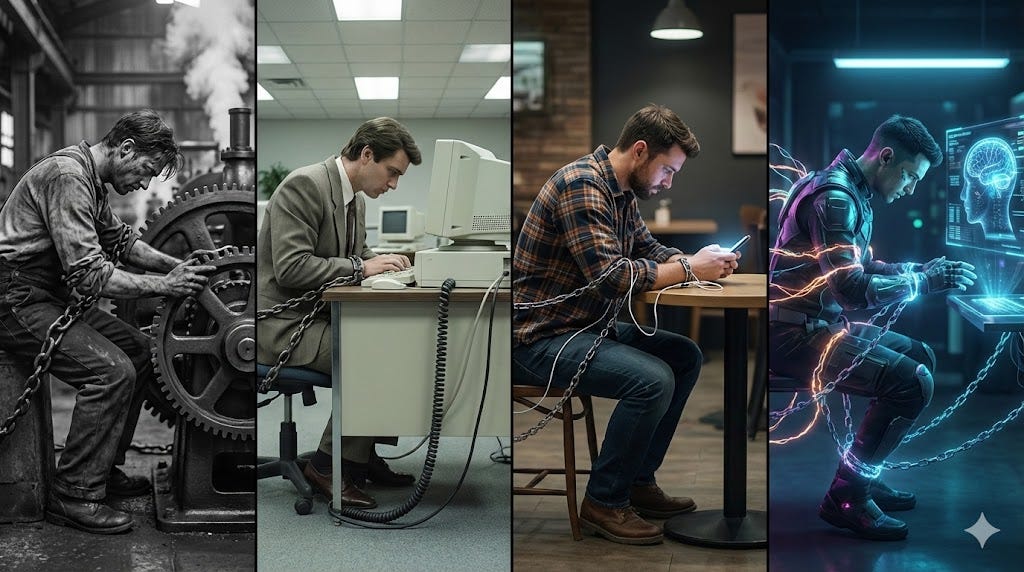
This isn’t a prediction. It’s already happening.
While I was writing this piece (February 9th), a Harvard Business Review study from UC Berkeley dropped. They tracked 200 tech workers at US companies over eight months after AI tool adoption. Did work decrease?
The exact opposite.
Three things happened. First, the scope of work expanded. PMs started writing code. Researchers started doing engineering tasks. AI gave everyone the feeling of “I could probably do that myself.” Work that used to go to another team or an outside vendor? Now it’s on your plate.
Second, the line between work and not-work vanished. Plugging in prompts over lunch. “Just one more prompt” before logging off. Checking results before bed. Prompting doesn’t feel like work — it feels like chatting. But when you look back, your breaks weren’t breaks.
Third, multitasking exploded. Writing code manually while simultaneously running AI on the side, spinning up multiple agents in the background, pulling out tasks you’d been procrastinating on. “I have a partner now, so I can handle more.”
One engineer in the study put it perfectly:
“I thought AI would boost productivity and I’d save time and work less. But in reality? You don’t work less. You work the same amount, or more.”
It’s the in-flight WiFi story all over again. Better tools, higher expectations. AI writes a report in 10 minutes — your boss says “great, write 5 more by end of day.” AI auto-generates code — “cool, add 10 more features by next week.” AI handles design — “perfect, give me 30 mockups.”
The total volume of work doesn’t shrink. It grows. Musk’s weekend vegetable garden isn’t coming.
But here’s where it gets strange. If work is increasing, why are people losing their jobs? If there’s more work to do, why are we seeing layoff headlines every single day?
Work Grows. Your Seat Disappears.

This is the real point. The total amount of work stays the same or increases. But the same people don’t keep doing it. We’ve seen this play out in history, over and over.
The 1870s: Telegraph Operators.
Telegraph operators were skilled specialists — the software engineers of the 19th century. They memorized Morse code from youth, practiced thousands of hours, and were only recognized as “experts” once they could tap out 40+ words per minute. Tens of thousands across America. Good pay. High social status.
Then the telephone arrived.
Twenty years of telegraph expertise became worthless overnight. No matter how fast you could tap Morse code, it meant nothing in front of a telephone. Instead, an entirely new profession — the telephone switchboard operator — exploded into existence. Mostly young women. People who could adapt to new technology quickly, with none of the “but we’ve always done it this way” inertia.
Work didn’t disappear. The entire communications industry grew explosively. But the people were replaced.
How many 45-year-old telegraph operators successfully transitioned to switchboard operation? Almost none. They were told to “retrain.” In theory, it was possible. In practice, erasing 20 years of muscle memory and starting over? It almost never happened.
The 1910s: The End of the Horse.
When Ford introduced the assembly line, building a car went from 12 hours to 2.5 hours. Productivity exploded. But here’s what’s interesting — as productivity rose, car prices fell. As prices fell, more people could afford cars. As more people bought cars, more cars needed to be built. The total amount of work didn’t decrease. It exploded.
But who did that work?
The carriage makers, harness craftsmen, and coachmen — their 30 years of experience went to zero. The skill of carving a carriage wheel was worthless in an auto factory. Instead, hundreds of thousands of unskilled assembly line workers were hired. The assembly line didn’t require craftsmanship. New people, new skills, new rules.
Work increased. But that work belonged to new people.
2007: The iPhone.
The day Steve Jobs announced the iPhone, the job title “app developer” didn’t exist on planet Earth. There was no concept of an App Store.
Ten years later: roughly 12 million people employed in the global app economy. A job that didn’t even have a name a decade earlier created 12 million positions. Uber drivers, Instagram marketers, YouTube creators — careers unimaginable in 2006 now supported millions of livelihoods.
But who got displaced? Dedicated GPS device companies. Kodak and the camera film industry. Brick-and-mortar travel agencies. The music industry. Professionals with 20 or 30 years of expertise in these fields got pushed out.
Try telling a senior engineer at a GPS company, “12 million app developer jobs were created, so it’s all fine.” That number means absolutely nothing to them.
See the pattern?
Every time technology shifts — total work is maintained or increases. That’s true. But displacement happens. People optimized for the old technology get pushed out and replaced by younger workers suited for the new one. Telegraph operators replaced by switchboard operators. Carriage artisans replaced by factory workers. Kodak engineers replaced by app developers. The displaced experts get swapped out. The people.
And the displaced hear the same thing every single time: “Just retrain.”
In reality, 45-year-old telegraph operators almost never became switchboard operators. 50-year-old carriage craftsmen almost never became Ford factory workers. 55-year-old Kodak engineers almost never became app developers.
A discarded class emerges. Every time. Without exception.
This is exactly what happened in the place this series is named after: Michigan.
The First Michigan
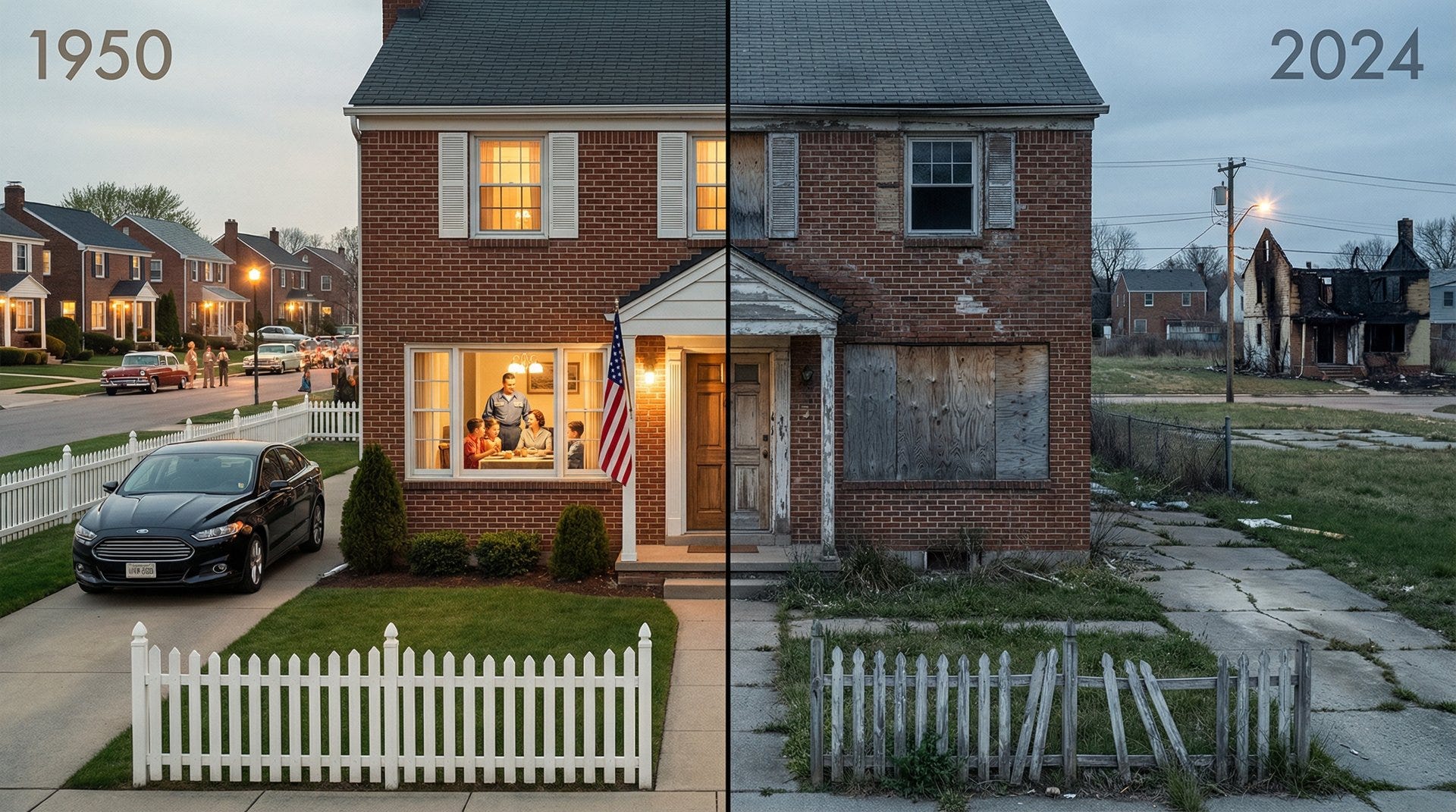
1950. Detroit. Population: 1.85 million. Fifth-largest city in America.
The rules were simple. Graduate high school, get a job at Ford or GM. Work hard, buy a house, send your kids to school, collect a pension. Your father did it. Your grandfather did it. Work hard and you’ll be fine. That was the social contract.
When factories moved overseas and automation began, car production didn’t decline. It increased. Global auto production kept climbing. Toyota, Hyundai, Volkswagen — all building more cars than ever.
Work didn’t disappear. Detroit’s workers were replaced. By younger workers in Mexico, by robots, and eventually by non-union plants in southern states. The exact same pattern as telegraph operators being replaced by switchboard operators. More work. Different people.
Detroit’s population today: 630,000. A 65% decline. Poverty rate: 35%. Child poverty: 50.2%. In 2013, the largest municipal bankruptcy in American history.
Numbers alone can’t capture it.
When a factory closed, the factory wasn’t the only thing that shut down. Think about it. The neighborhood plant closes. Two thousand workers lose their jobs. The diners where those 2,000 people ate lunch every day lose their customers. The diners close. The diner owners can’t pay taxes. City revenue shrinks. School budgets get slashed. Schools deteriorate, so young couples with kids leave. Young people leave, and the only ones left are the ones who can’t leave. No jobs, no mobility, no safety net. Drugs spread. Families disintegrate.
This wasn’t an economic problem. An entire community collapsed like dominoes.
And what did the elites say?
“Learn software.” “Retrain.” “Adapt to new industries.”
To people whose entire foundation of life had been obliterated, that wasn’t a solution. It was an insult. For 40 years, they followed the rules faithfully — and then they were told, “It’s your fault you couldn’t adapt.” We didn’t make the rules. We didn’t change them. And now we’re the problem?
This isn’t just an American story. Britain’s Rust Belt. Korea’s Gumi and Geoje. Japan’s regional cities. The same pattern repeated worldwide. When industry leaves, people leave. When people leave, communities die.
And economic displacement doesn’t stay economic.
It becomes ideology. It becomes politics. It changes history. The displacement of the Industrial Revolution gave birth to communism and world wars. The 30-year accumulation of betrayal in Detroit split America in two. Michigan, Wisconsin, Pennsylvania — all three were ground zero for manufacturing hollowing-out, and all three decided the presidential election.
I’m not trying to make a political argument. I’m stating facts. Economic displacement inevitably flows into social fracture. (I’ll go deeper on this in Part 3.)
“Next Michigan”

The first Michigan targeted blue-collar manufacturing workers.
The second Michigan targets the entire college-educated white-collar workforce.
“This time is different”? That’s what they said every time. “This technology is different — it’ll actually reduce work.” They said it about Excel. About email. About smartphones. It never happened once. The HBR study I cited above already proves it.
By US Bureau of Labor Statistics data, roughly 70 million Americans work in “Management, Professional, and Related Occupations.” That’s 44% of the total workforce. Not a few times larger than Michigan’s auto workers — dozens of times larger.
Same pattern. Total work won’t decrease. It’ll increase — because AI raises expectations. AI writes a report in 10 minutes, you’ll be told to write 5 more. AI generates code, you’ll be told to add 10 more features. More work than ever.
But the people doing that work will be replaced. AI-native generations will enter, and those optimized for the old way will be pushed out. Exactly like telegraph operators. Exactly like carriage craftsmen. Only this time, three things are different.
Scale. Detroit’s displacement affected millions. This time it’s tens of millions. 70 million in the US alone. Globally? A number you don’t want to think about.
Speed. Detroit took 30 years to collapse. Slowly enough that people could tell themselves “it’s still fine.” AI needs just a few years. I built AI VC Reports in 30 minutes. Not 30 years — 30 minutes.
The intensity of the rage. This is the scariest part. The betrayal felt by a high school grad who went straight to the factory is categorically different from someone who invested four years of college, two years of grad school, unpaid internships, and endless job applications. Massive student loans, hundreds of interviews, all while believing “just follow these rules and you’ll be okay.” The more time and money invested, the sharper the rage of “I followed every single rule.” It’s no coincidence that politicians keep trying to cancel student debt.
And this time, the elites telling people to “just adapt” are telling it to themselves.
Everyone's Watching the Wrong Fire

In 2025, 245,953 tech workers were laid off across 783 companies. Since ChatGPT launched in late 2022, the cumulative total exceeds 500,000. Layoffs explicitly citing AI as the reason: 54,694.
2026? In January alone: 35,000. That’s 856 people per day. Amazon alone cut 30,000 — 10% of their workforce. Meta: 1,500. Oracle is reportedly considering an additional 30,000 reductions. It’s still February.
Layoffs are loud. They make the news, blow up on Twitter, get questioned in Congress. The numbers are visible. The names are visible. There’s a target for the anger.
But everyone is looking in the wrong direction.
“AI is killing junior roles.”
That’s the line you hear most in tech right now. The Stanford-ADP paper came out. UK graduate hiring down 67%. US down 43%. The numbers look terrifying. I wrote about this topic myself last September in a piece titled “It’s the Economy, Stupid.”

My conclusion then: this isn’t AI — it’s a recession. When downturns hit, companies freeze new hiring before cutting existing staff. That’s a textbook pattern in labor economics. The weakest link — entry-level and junior hires — is the first door to close. AI didn’t replace them. The door slammed shut before they could walk through it.
I still believe that. In the short term, junior workers are suffering because of the economic cycle and outsized fear.
But let me push one step further.
In the medium to long term, juniors actually have the advantage.
Forrester Research found — unsurprisingly — that Gen Z has the highest AI readiness score (AIQ) at 22% across all generations. Boomers: 6%. Gen Z has zero resistance to learning new tools. No “but we’ve always done it this way.” Someone who’s invested 20 years into the current way of doing things can’t abandon it. But someone who hasn’t invested in anything yet can start fresh on day one.
When new factories were built after Detroit’s decline, they weren’t staffed by 20-year assembly line veterans. They were staffed by new people with new skills.
The real target of the quiet restructuring isn’t juniors. It’s the existing workforce.
And companies know this. According to Forrester, 55% of employers who used AI as a reason for layoffs already regret it. Half will quietly hire people back. But at lower salaries, overseas, or at the junior level. They’re not recalling the displaced seniors. They’re finding people who are cheaper, more flexible, and better at using AI.
This time, it’s not the factory that closes. It’s the office. And you’re the one being displaced.
So What?
Musk’s vegetable garden isn’t happening. Total work isn’t shrinking. It’s growing.
But your seat might vanish. Not because work is disappearing — because the person doing the work is being replaced. Just like telegraph operators. Just like carriage artisans. Just like Detroit autoworkers.
And history tells us one more thing simultaneously. Every technology transition has followed a pattern. Every time, they promised “this time, humans will be free.” Every time, it was a lie. Every time, they told the displaced to “just retrain.” Every time, it was an insult. The real answer was always somewhere else entirely.
If you’re college-educated, white-collar, a developer, someone who followed the rules — if you’ve been doing what you’re told, staying comfortable in the direction handed to you...
What exactly makes you different from a Michigan factory worker?

In the next installment, I’ll talk about how to survive inside that storm. One hint: the answer isn’t where you think it is.
🔴 Next: [Next Michigan, Part 2] — “Surviving the Storm: Look at the North Star, Not the Wave in Front of You”
If this series resonated with you, please share it with someone who needs to hear it.
And honestly, wouldn’t this be the perfect setup to pivot to: “Want to learn how to survive in this world? Just sign up for my course! For the low price of $3,000, you too can learn to build an AI automation empire! Solo founder! One-person unicorn! If you could change your financial future, isn’t that a bargain?!”
Thanks for reading, as always.
— Ian