

1. AI Is Changing the World — But
AI is genuinely revolutionizing how we work and live. Presentations, code, data analysis, research — tasks that used to eat hours now get done in minutes, and the output looks pretty convincing. We’re experiencing a massive productivity leap, and it’s a foregone conclusion that people who use AI well will have an overwhelming advantage over those who don’t.
But AI’s limitations are equally clear: no real accuracy, no real creativity, no real reasoning. (I covered this in detail with examples in this piece.) The latest evidence? On April 20th, TechCrunch reported that hallucination rates in the newest AI models have actually gotten worse. According to the PersonQA benchmark, o4-mini hit a 48% hallucination rate.
So no — the prediction that AI will fully replace humans across every domain is premature. AI is a powerful tool, but fully replacing human creativity, intuition, empathy, and ethical judgment? We’re not there. Not even close.
2. Not Full Replacement — Workforce Restructuring
AI won’t replace all human workers. But it will fundamentally restructure the workforce. If you’ve used AI yourself, you already know this: presentations, data collection and analysis, basic research, first-draft reports, information retrieval, simple coding — the tasks that juniors primarily handled are now being done by AI faster, cheaper, and convincingly enough.
The problem? Because of unavoidable hallucinations, AI output is never perfect. It requires expert review. And this is where juniors face a brutal catch-22: they don’t yet have the experience or expertise to catch AI’s mistakes, provide strategic direction at a high level, or understand and communicate industry-specific context.
The result: experienced experts (note: not all seniors are experts) become dramatically more valuable. Their productivity skyrockets because AI tools let them handle exponentially more work than before. Meanwhile, the tasks that defined junior roles get automated overnight.
3. Only the Best Juniors Survive — So What Should You Do?
What are juniors supposed to do about this? I know the advice sounds obvious, but I can’t not say it. Here’s my framework for becoming one of the few juniors who survives long enough to become an expert:
First, master AI tools. Know what the latest tools are, how to optimize them, and how to orchestrate multiple AI tools together. This is table stakes.
Second, demonstrate overwhelming productivity through automation. Use AI so skillfully that your output is incomprehensible to people who don’t. Turn a 4-hour task into a 10-minute task. That kind of gap.
Third, develop critical thinking and problem-solving ability. Don’t blindly trust AI output. Build the judgment and logic to verify and evaluate it yourself. Developing genuine critical thinking and insight isn’t easy, but the alternative is being a parrot who relays other people’s words — and AI already does that infinitely better than any human.
Fourth, lean into creativity. Original ideas and approaches that machines can’t easily replicate will become more valuable than ever. This isn’t just about creative deliverables — it’s about the mindset of constantly breaking established playbooks and finding better methods.
Fifth, invest in soft skills. This is surprisingly undervalued in Korea, but communication ability, situational awareness (눈치 — the Korean concept of reading the room), collaboration, leadership, and adaptability are fundamentally about navigating human-to-human relationships to produce outcomes. AI can’t do that.
4. But Do You Even Need a Traditional Job?
Let’s be honest: integrating AI into existing systems structurally favors senior experts. They’re the ones with the experience and knowledge to verify and leverage AI output. But this is also the best era in history for building something of your own.
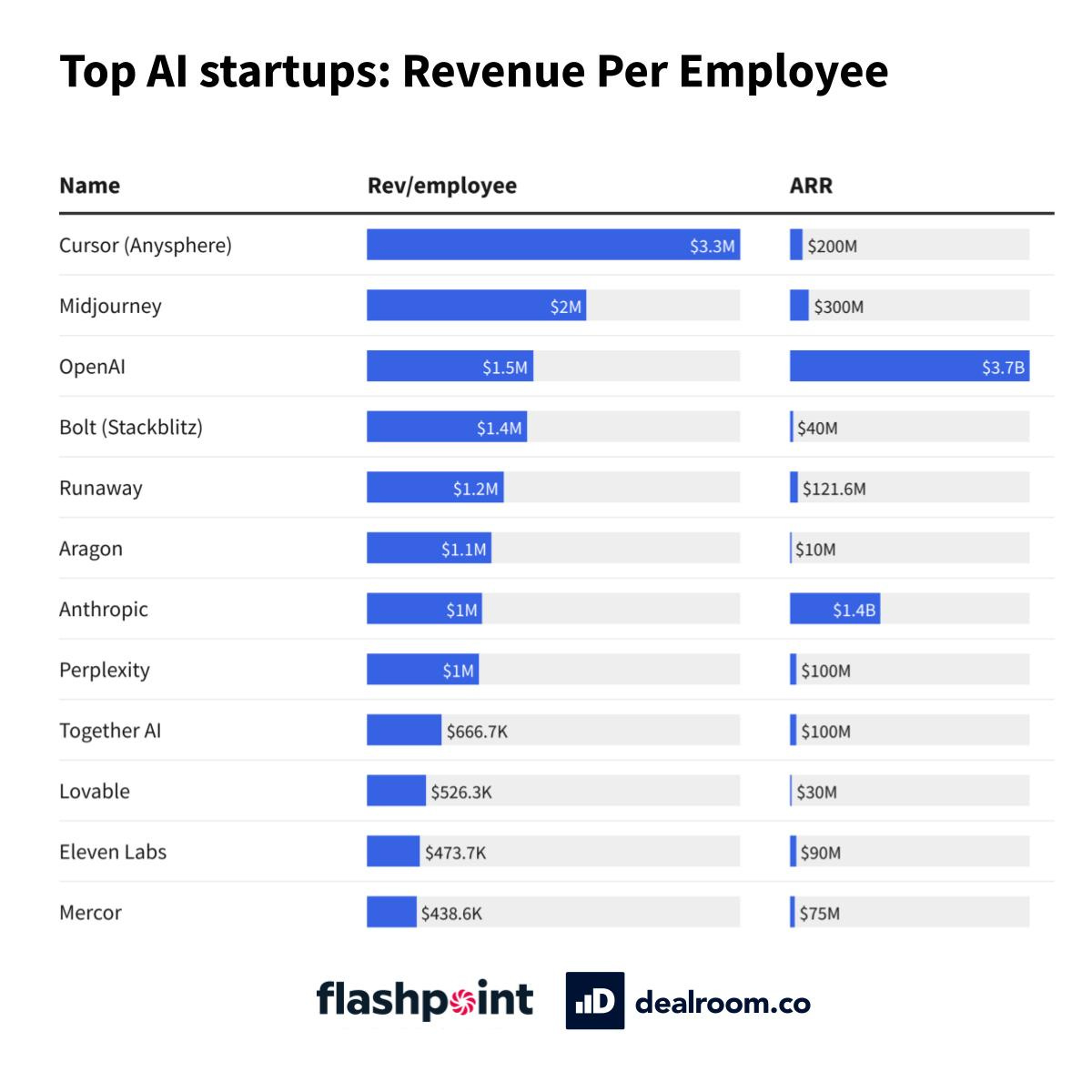
AI has dramatically lowered the barriers to entrepreneurship. I’m not talking about the “one-person unicorn” fantasy — that’s inefficient nonsense. What I mean is that elite small teams can now attempt things that previously required enterprise-scale resources. Plenty of startups are already proving this out. (Though let’s be real — Cursor’s $3.3M revenue per employee is impressive until you realize OnlyFans does $39M per employee. Not even close. 😂)

So rather than trying to apply AI within existing systems — where experts have every advantage — consider building entirely new business models and services from AI. For juniors who lack deep industry experience, that “disadvantage” might actually be an asset. Less baggage means more first principles thinking. Less institutional knowledge means fewer constraints on imagination. AI has opened the door for people to build new products, create new markets, and upend existing order from the ground up.
AI is simultaneously a massive threat and an unprecedented opportunity for juniors. The key is not fearing the change, but running headfirst into it and searching for new possibilities. I know “crisis is opportunity” is a cliché, but it fits perfectly right now.
Are you a junior in crisis mode building a product that could change the world with AI? Reach out to me at ian@ianpark.vc. The crazier the idea — the kind where everyone says it can’t work, that you’re insane — the more I want to hear about it. And as I always say: I’m not the answer for every startup. If we’re not a fit, find a VC who’s crazy in the same direction you are. You only need one.
5. Where Is This All Heading?
I’ve said this many times: this generation of AI software shouldn’t aim to replace humans. It should aim to extend them. That’s more realistic and more meaningful. But it also means competition among humans intensifies, and becoming one of the few high performers will require increasingly brutal effort.
At the same time, if this innovation cycle continues, high performers keep getting more powerful while everyone else falls further behind. Polarization accelerates. The internet, mobile, and cloud already widened inequality. AI is going to pour fuel on that fire.
Setting politics aside and looking at this coldly: I think universal basic income becomes necessary. Not out of welfare or compassion — but from a purely capitalistic perspective. The productivity gains of American high performers are extraordinary. But the extreme polarization those gains create risks the kind of instability we saw on January 6th. UBI might be the most self-interested policy the establishment can adopt to protect what they have and enjoy it safely for the long term. The prerequisite, of course, is that AI-driven productivity gets so high that a small number of workers can sustain a baseline quality of life for everyone.
That tangent went longer than planned. 😂 I’ll try to write shorter and more frequently going forward — if there’s a topic you want me to go deeper on, drop into the KakaoTalk group and ask! Thanks for reading, as always.
(Bonus) Will VC Analysts Get Replaced Too?
Yes. Obviously. I think it’s an inevitable trend. The logic is the same as every other field: experienced investors with networks will get more productive with AI, while junior analysts without sufficient industry understanding will gradually be replaced.
In practice, I already outsource most of my research to Google’s Deep Research and just edit the output. Compared to the old process — giving juniors the big picture, requesting revisions, reviewing their work — it’s honestly not much more effort. The parts I consider most important — meetings and reference calls — I have to do personally anyway. And if I’m being real, I actually save time by not having to mentor and manage people on top of the actual work.
So what should aspiring VCs do? That’s a longer conversation I’ll tackle in a separate “What Makes a Good VC” newsletter. Stay tuned.
As for me — I think about my own replaceability constantly. My current conclusion: as long as there exists information that people can’t write publicly online, can’t say officially on the record, and only exchange privately through personal relationships — one piece at a time, favor for favor — I’d like to believe I have at least one weapon that AI doesn’t.