

This is an old post from 2023, originally written in Korean while I was at KIC as an LP for VC funds.
I want to go back to the basics and think about what VCs actually do and what it takes to be good at it. Simply put, it might be "to find a company that will become big earlier than others, invest in it as much as possible, and earn the most money" So, I want to think about how this is done and how to do it well.
First, let's organize the basic functions of a VC.
1. Source
This is the stage where VCs find companies to invest in. It's primarily the main job of junior VCs and involves several methods: (1) sifting through numerous online databases and articles to identify and contact promising companies, (2) filtering companies that have reached out to the VC first, or (3) using databases more professionally (e.g., via API) to find companies that fit a specific profile they are looking for.
The daily life of an analyst at a once-successful large funds... though they are said to be unemployed now.
Another approach is to use personal connections, a method more commonly used by senior VCs with extensive industry network. This involves leveraging their network through (1) connections of founders they previously invested in, (2) their own past networks, (3) contacts made through co-investments or on boards of directors, or (4) finding opportunities through networking events.
From my perspective, the VC world is still a market where personal connections are more effective. This creates a barrier to entry, making networks crucial and, at the same time, making the market inefficient, which is the basic idea behind expecting higher returns.
However, relying solely on networks can be somewhat sporadic. Therefore, many funds also use data-driven approaches simultaneously. I believe SignalFire and Goodwater are firms that are truly serious about using data.
To address this, some firms take a top-down approach in addition to using data, and I think Bessemer Venture Partners (BVP) is a prime example. Unlike most VCs who typically find companies through connections and then research the field, BVP often, as seen on their website, researches and identifies promising sectors first and then seeks out the best companies within those sectors. Of course, a blend of both methods is optimal, but I find BVP's approach more repeatable and original, making it well-suited for VC investing.
2. Pick
This is the stage of selecting which company to invest in. After finding a sufficient number of good companies, you must choose the ones worth investing in and execute the investment.
Personally, I believe "Pick" is the most crucial competency for a VC. There are no set rules for picking. It's not something that succeeds just because everyone agrees, nor does success guarantee future correct picks from the same person. It's an art that requires making the best possible decision in a new situation for a new asset, with a bit of luck involved.
Naturally, there's a tremendous amount of thought that goes into how to pick well. Even the decision-making structures vary widely. Some use a majority vote, some require a unanimous decision, and others have no voting at all, with partners investing from their individual budgets each year. Personally, since I believe VC is not scalable and is more of an individual endeavor (e.g., Benchmark), I think it's best to listen to everyone's opinion but make the final decision alone.
Another effort to improve picking is understanding the market. I believe successful VCs are always busy not just networking, but also constantly studying, researching, and learning from experts. They strive to make the best picks by continuously thinking about their investment areas, the broader market and regulations, and new potential investment sectors.

Constant study is important, but are they just chasing endless trends?
3. Win
In the past, when there were fewer VCs, finding and picking a good company was enough. Nowadays, you often have to win an investment competition. You have to persuade the founder to take your money over that of other VCs.
I think this is partly due to the abundance of liquidity in the market and also because information has become so common. With the rise of various databases and an increase in the number and scale of accelerators, what looks good to me is bound to look good to others, and everyone can see it. In fact, the VC scene has been operating this way since 2021. The increased number of VCs with more capital has led to competitive, high-priced investments. I believe the result will be a deterioration in the returns for many VCs over the next 10 years. It's absurd to think you can generate alpha by competitively buying what everyone else thinks is great at a high price.
Anyway, moving on. While a VC's reputation, expertise, and other factors are important in winning a deal, the chemistry between the founder and the VC seems to be surprisingly crucial. In the past, money from a big fund was always preferred. However, looking at founders around me these days, they find that large funds can be rather impersonal, don't give much attention, and can become calculating when things go south. As a result, we're seeing cases where founders take just enough from a large fund for the "stamp of approval" and then choose investors with whom they have a good fit. Smaller funds are still growing and have fewer portfolio companies, so they are perceived as more likely to pay closer attention, both for their reputation and their numbers.
This "fit" can depend on many factors: how well the founder and investor get along personally, the investor's personal charm (the "I want to work with this person" feeling), the investor's style (coach vs. cheerleader), and the investor's expertise (whether they give nonsensical "advice"). Ultimately, I think what matters most is how much the founder likes the investor. Frankly, from an investor's perspective, you're more motivated to help a founder you like. Personally, I believe life is too short, so it's best to meet founders whom I respect, want to help, and want to partner with for the next 10 years. If that feeling is mutual, it's the best-case scenario.
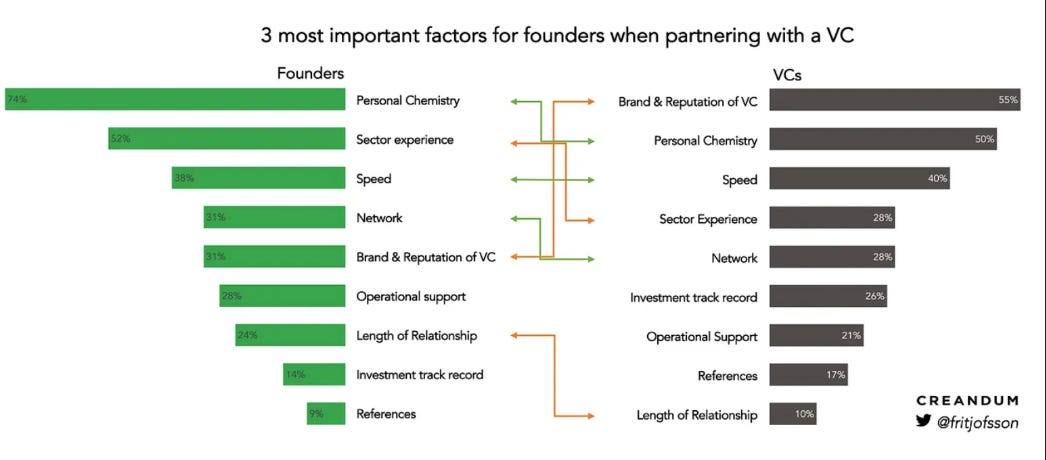
Founders value Personal Chemistry and Expertise the most, while a VC's Brand is surprisingly fifth. In contrast, VCs think their brand is the most important thing... lol
4. Support
This is the stage of helping invested companies grow faster.
Personally, rather than ordering them around ("do this, do that!") or micromanaging, I believe it's more ideal to trust that the founder, for whom the company is their entire life, has thought about things much more than I have. I should support their decisions to the best of my ability and do my utmost to help when they ask for something. Shouldn't a great founder be able to succeed without a VC teaching them every little thing? Of course, the idea of nurturing a promising founder has its appeal, but I question whether VCs have the time for that.
I also think that having huge in-house teams and dispatching them to portfolio companies is difficult and uncomfortable for both parties ("Oh great, the master's youngest son has come to put out the fire at the frantic servant's house...?"). I find it cleaner to use your network to introduce good team members or connect them with consultants.
5. Exit
This is the stage of realizing profits by selling the shares of the invested company.
To be honest, VCs often don't consider "Exit" as part of their job. They naturally assume an IPO will happen. But that was back in the days when IPOs would soar. I'm starting to think that exiting is now a more important art than investing.
I believe now is the time to think about various exit strategies, including M&A and secondaries. Therefore, I believe that knowing when to exit (e.g., 2021!!!) and being able to creatively solve this can differentiate one VC from another. The funds that managed to exit as much as possible at the 2021 peak, which we won't see for a while, will be happy for the next 10 years. This suggests that the ability to read exit timing might become a key competency for VCs for some time.
"If you buy high, can't you just sell higher? Hehe"
So what?
Actually, a topic I've wanted to write about more than this is how to evaluate whether a VC is good or not based on these functions. It's an area I'm still contemplating and one I expect will continue to evolve, so I've been putting it off. Nevertheless, now that I've organized their functions like this, I'll use it as a basis to further discuss what it means to do it well.