

First Principles Thinking Has Never Been More Necessary Than Right Now
If you’ve been reading my newsletter, you know I’ve been pretty bearish on vibe coding and GPT wrappers. I’ve written about how vibe coding is a security nightmare, why solo/small teams will inevitably hit a wall, and why “speed is our only moat” is a fundamentally flawed thesis.
The pushback I always get? “But vibe coding companies are doing great!” or “GPT wrappers like Perplexity are killing it!” My answer has always been the same: “Companies take a while to die. Be patient.”
And now, the dying patterns are starting to show.
The Retention Data Doesn’t Lie
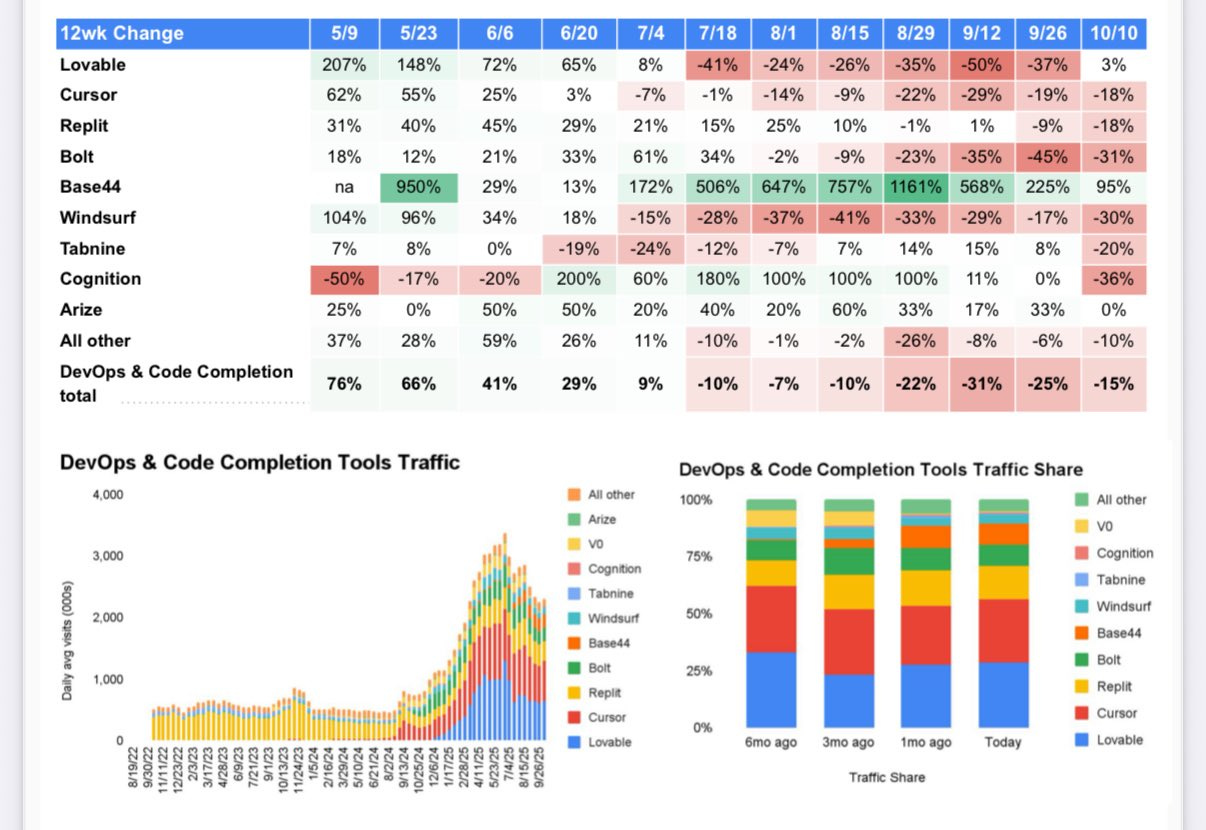
Chamath — who admittedly gets it right sometimes — shared this data on X showing 12-week cohort retention for vibe coding platforms. The picture isn’t pretty. The deeper you go into the cohorts, the more red you see, which means one thing: users are churning hard. People sign up, try it once, go “meh,” and bounce.
These platforms are essentially Claude wrappers. And as someone who values retention roughly 100x more than top-line revenue growth, this data does not signal an industry heading in a healthy direction.
The Obvious Limits of Vibe Coding: A House Built on Sand
I’ll give credit where it’s due. Vibe coding genuinely helps skilled developers boost productivity. It’s useful for quick MVP testing and building simple internal tools. Think of it like the Excel macros (VBA) that companies already build to automate tedious tasks — vibe coding handles that reasonably well.
But here’s the thing: you can now just use Claude Code directly from Anthropic to build those simple tools. You don’t need a dedicated vibe coding platform for that.
So can vibe coding build a real product that changes the world? Not a chance.
There’s no competitive advantage. If anyone can build it, there’s inherently no barrier to entry. The moment someone makes money with a vibe-coded product, someone else clones it overnight. Market defense is impossible.
Maintenance is a disaster. AI that can’t think independently — that just pattern-matches and stitches code together — produces something that looks functional on the surface. But it’s a ticking time bomb. Try adding one feature or fixing one bug, and the whole thing collapses.
You can never be the best. Great products demand meticulous architecture and craftsmanship. Vibe-coded products have neither depth nor durability. A clever idea might generate a brief spark, but without a moat, retention drops, and Google or a more polished team eventually eats your lunch.
Companies might use vibe coding for experiments or internal tools. But no serious business will entrust its core software to it. That’s why I’m confident that vibe coding tools — which are ultimately just Claude wrappers — won’t become mainstream. The “one-person unicorn” era isn’t coming. The “teams don’t need engineers” future isn’t happening.
The Dotcom Parallel: Namo Web Editor and Cursor
A funny analogy hit me recently. What we’re living through right now feels exactly like the dotcom era, when Namo Web Editor came out and everyone declared that web development would be fully automated.
For those unfamiliar, Namo Web Editor was a Korean WYSIWYG (what-you-see-is-what-you-get) HTML editor that was huge in Korea during the late ‘90s and early 2000s. Back then, simply being able to make a website was extraordinary — that’s the pre-vibe-coding era equivalent. Namo Web Editor was essentially the Cursor of the dotcom bubble.
So let’s all answer together: Did web development get fully automated?
Sure, it got easier for personal sites and nonprofits. But the websites that actually compete on quality? They got more beautiful, more complex, more sophisticated. As user expectations rose, web development evolved into a domain requiring deep expertise. Demand for great developers kept increasing. All Namo Web Editor solved was the simplest layer of the problem — which freed real developers to focus on higher-order challenges.
The same logic applies here. AI-powered coding tools aren’t opening the door for regular people to build world-class apps and get rich. They’re giving professional programmers the bandwidth to tackle harder, more complex problems than ever before.
So What Happens Next?
AI coding tools won’t just make existing things faster. They’ll make previously impossible things possible. We’re talking about an entirely different dimension of products — paradigm-shifting stuff.
Claiming vibe coding will replace programmers is like standing at the dawn of the internet and having no concept of what an iPhone app or VR/AR experience would look like. We’re going to encounter entirely new forms of human-computer interaction (HCI) that aren’t websites, aren’t mobile apps — something we can’t even imagine yet.
Technology has always created complexity and functionality beyond our imagination. This drives fiercer competition, which demands better talent, more capital, and longer timelines.
The AI era won’t be an exception. The nature of the work will change, but demand for elite developers will only increase.
First Principles Thinking Has Never Mattered More
I’m bearish on vibe coding platforms, but let me be clear: AI genuinely boosting skilled programmers’ productivity is a great thing. It frees top-tier engineers to work on higher-order problems. That’s unambiguously positive.
But this means we need to completely rethink the frameworks we inherited from the internet and mobile eras. We have to break out of old mental models. Building existing web apps and mobile apps faster is not how you win in this era. Truly great companies will build something beyond that.
What does that look like? Honestly, I don’t know yet. But it will likely involve hardware evolution alongside software — most people seem to agree on that much.
Getting there requires going back to the most fundamental question: “What problem are current websites and mobile apps actually solving for consumers?” Start from zero. No assumptions, no inherited frameworks. Pure first principles thinking.
Take Gamma AI, for example. They’re doing well, but at the end of the day, it’s a wrapper that makes PowerPoints faster. When Google Slides or a better tool shows up, it gets replaced instantly.
For a company like that to truly succeed, the question can’t be “How do we make PPTs better and faster?” It needs to be “How can AI help people communicate business ideas more effectively?” — and then build the answer from scratch.
Don’t “automate PowerPoints with AI.” Make AI do what PowerPoints were trying to do, but better.
Don’t “automate web browsing with AI.” Make AI accomplish what users were trying to do in the browser, but easier and faster. (This is exactly why ChatGPT’s Atlas felt so uninspiring to me.)
We’re not in an era of speeding up old frameworks. We’re in an era of replacing the frameworks entirely. The companies that go back to a blank sheet of paper, identify the fundamental problem these tools are solving, and rebuild the solution from the ground up using the best technology humanity has ever had — those will be the great companies. And I genuinely hope one of those founders is a Jushibal subscriber (who I’ve invested in, haha).
One Last Thought: The Addiction to Quick Wins
I’ll close with something I plan to write about more in a future newsletter. Since 2021, excess liquidity has made “fast exits” and absurd valuation jumps feel like the new normal. The market got addicted to quick money, and a lot of people are chasing that high blindly. (On the bright side, social media and viral marketing make it very easy for founders with flawed thinking to broadcast those flaws publicly — which actually makes VC due diligence easier.)
Here’s what I believe: early success does not guarantee final success. Hollow viral growth is closer to a death sentence than a victory lap. Startups are a brutally long game — 10 years or more of enduring doubt, ridicule, and loneliness while pushing forward. (I feel this more now that I’ve left my own comfortable nest.)
So to the founders reading this: don’t get arrogant from early wins, and don’t get crushed by early failures. Building a startup is a challenge and a process, not a destination. This was never supposed to be easy. What matters is keeping a long-term perspective, staying steady, and moving forward together. I know this road is lonelier and harder than anyone admits. I’m rooting for all of you, and I hope I can be of help along the way.
Thanks for reading, as always.
— Ian