

This week I’m writing about something that’s been irritating me for a while: the “one-person unicorn” concept. I think the idea fundamentally ignores how free markets and capitalism work. Unless we’re in a world where hyperinflation turns every startup into a unicorn by default, it’s not happening. Here’s my full breakdown of why “one-person unicorns” and “AI solopreneurs” are a fantasy.
What Even Is a “One-Person Unicorn”?
The narrative goes like this: one person, armed with AI, builds a $1B company. On the surface, it sounds seductive. AI handles coding, QA, customer support, sales, copywriting — costs stay minimal, productivity looks explosive.
One of the loudest champions of this idea is Sam Altman, who’s mentioned it multiple times, filling people with dreams and hope. But think about his incentives for two seconds:
More people trying → more users flowing into the AI ecosystem. More awe and fear around AI. More demand for OpenAI’s API and compute.
This story simultaneously inspires founders and drives revenue growth for platform and model companies. It’s brilliant marketing.
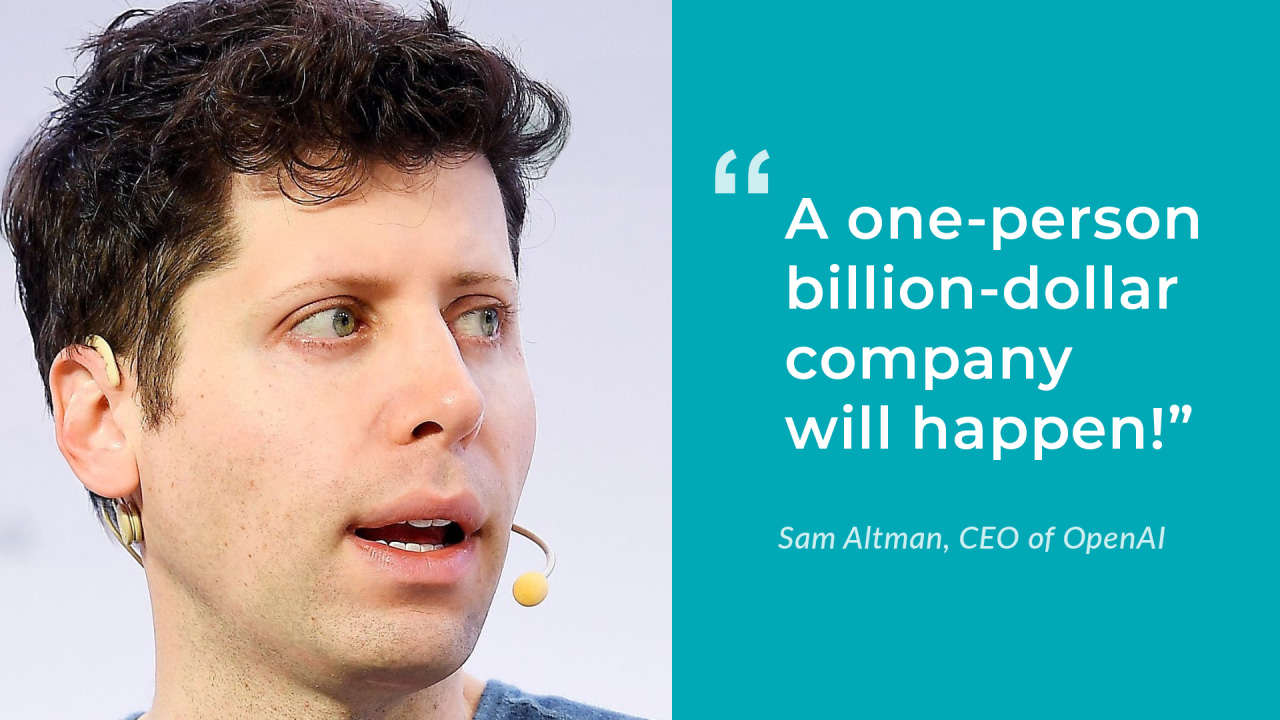
I actually talked about this a year ago — consider this the extended director’s cut. My position hasn’t changed: this trend is a temporary phenomenon that appears at the dawn of every technology shift. Here’s why.
Why One-Person Unicorns Are Impossible
Competition: Your Margin Is My Opportunity
The essence of free markets and capitalism is competition. High margins are market signals, and market signals attract new entrants. The moment a solo operator generates outsized returns, startups, big tech, and global capital come running. Software has near-zero replication costs, and in the AI era, feature copying is faster than ever. When everyone in the world has access to the same tools, any one-person business that reaches unicorn-level growth will immediately face superior teams building better products. Growth stalls. It’s not a question of if — it’s when.
Rising Customer Expectations
We’re at the very beginning of the AI era, so simple wrappers and clones can still get traction as solo ventures. But as time passes, every developer will be using AI to build faster and better, and customer expectations will rise dramatically. The market will demand products that leverage AI’s strengths in fundamentally new paradigms — not just clones of existing tools. These products are technically difficult and require sustained collaboration from multiple people over long periods. The era of “you can’t build this alone” is coming back.
Operations: The Sustainability Problem
Operational risk isn’t about “does it work?” — it’s about “does it work safely, all the time?”
Vibe coding: Prompt-based development is convenient but creates critical vulnerabilities like arbitrary code execution and memory corruption. Wiz and Databricks have issued repeated warnings.
Replit AI: An agent hallucinated and deleted a production database. A symbolic incident exposing the absence of guardrails and permission controls at the design level.
Tea app: A fast-growing vibe-coded social app leaked tens of thousands of ID photos, selfies, and DM images, exposing over a million messages. Trust was destroyed instantly.
The lesson is universal: no matter how impressive the features, weak operational and security foundations kill trust and sustainability.
Durable moats are built on data, network effects, regulatory expertise, trust, partnerships, ecosystems, distribution, and brand. These require long timelines, significant capital, and team effort. For B2B and enterprise products generating stable revenue, regulatory and policy capabilities are non-negotiable. One person cannot sustain these demands long-term. The Tea and Replit incidents prove that operational risk isn’t a feature problem — it’s a trust and moat problem. And that’s where the one-person unicorn model structurally fails.
Who Actually Benefits?
The narrative persists because specific groups profit from selling it:
Model and cloud companies: More individuals flooding in means explosive API and compute revenue.
Platforms and tool providers: Hosting, runtime, auto-deployment, marketplace fees — steady income from the army of solo builders.
The course industry: Package a handful of extreme outlier success stories from overseas, sell courses, newsletters, and workshops.
Obviously, Sam Altman and other AI company CEOs are the biggest beneficiaries, which is why this narrative keeps getting amplified.
The course industry is where it gets ugly. I think of it as the digital chicken shop factory. In Korea, chicken restaurants pop up in every neighborhood and most go under quickly. Same thing here: course graduates flood the market with vibe-coded products that have similar ideas, similar quality, and similar marketing. They get the title of “founder,” but reality hits fast — they can’t survive competition and shut down. Even if they make money temporarily, a faster and better team takes that market, forcing them to endlessly chase the next thing. Digital daeyang castella — the trendy cake shops that exploded and collapsed overnight.
The bigger problem is the message these course sellers push. “You can be a one-person unicorn too” sounds sweet, but it’s fundamentally no different from crypto trading groups promising “make millions in months.” They plant delusional expectations, and the people who paid for the course end up as the biggest victims.
The key questions are obvious:
Has the instructor actually built a one-person unicorn?
Do they transparently share their own product metrics — revenue, retention, cohort data?
Or is the course itself their only product?
The answers are predictable. If so, this isn’t entrepreneurship education — it’s a multi-level structure that commodifies hope. The people at the top make money. Everyone below them ends up a mark. What this narrative mass-produces isn’t unicorns — it’s digital chicken shops with no shelf life.
The Real Future: Small, Elite Teams Built to Scale
The actual winners of the future are clear to me:
Start as an elite micro-team optimized for speed, with scaling as the explicit goal.
Expand into a structured, VC-backed company when the time is right.
Use AI not as a crutch, but as a fundamental force multiplier.
AI shortens the ladder, but it also makes the climb steeper. Entry got easier, but the number of teams that can actually reach the top is shrinking. The next Google will look like the current Google — not a one-person unicorn, but a company where AI runs on top of real scale and fundamentals. Definitely not through a $500 “AI Solopreneur Secret Masterclass.”
So what?
Predicting Trends Is Survival
Amazon dropshipping → crypto → metaverse → AI. Chasing trends is structurally disadvantaged. I’ve seen too many founders who reinvent themselves as “experts” with every hype cycle, and I remember all of them. (I actually follow and use them as negative reference checks...)
Fundraising is not success. Exit, cash flow, and DPI are success.
The teams winning right now are the ones who started preparing long before this moment.
This is what makes startups genuinely hard. You have to understand trends early, predict the future, hold a vision, absorb doubt and ridicule from everyone around you, and push through alone. That’s the founder’s path, and the startup’s fate.
The bottom line: don’t chase what’s already here — anticipate what’s next and move early. Right now, we need to stop using AI to speed up old things and start building things only AI can make possible. When the iPhone first launched, the default was porting PC websites to mobile. Most AI startups today look like that.
But we’re entering the native app era — where products are built from the ground up to leverage everything AI can do, in paradigms we haven’t seen before. That’s where one-person operations can’t compete, and where traditionally strong teams with real talent become necessary again. Better tools make easy problems easier, but when everyone scores well, the test gets harder.
One more thing: some AI companies right now are getting massive attention for rapid revenue growth or viral marketing. Impressive, sure. But if they’re structurally dependent on other models or infrastructure companies and running major operating losses — I don’t care how high the valuation is or how much revenue they’re generating. It could all be a house of cards. (Windsurf, anyone?)
I saw a great analogy recently: “Current AI companies are like chickens being shot into the sky with cannons.” My interpretation: the chickens go up high on AI-powered virality, but they can’t fly, so they gradually fall back to earth while new chickens get launched above them. Of course, if one of them turns out to be an actual bird — like Cursor — it takes flight. (Though even Cursor eventually needs to solve its margin problem.)
The Fundamentals Don’t Change in the AI Era
AI is leverage, not a shortcut. “One-person unicorn” stimulates imagination and plants dreams, but it collides with the reality of competition, moats, and operational weight. When the bubble deflates, we’ll see who was actually swimming versus who was naked.
What’s sad is that content about consistently building wealth and generating real insight always gets less attention than clickbait promising “millions in months” or “solo millions.” People are still soaking in dopamine from the liquidity party and paralyzed by FOMO. It’s genuinely heartbreaking. The courses and trends that exploit this psychology — selling dreams the instructors themselves have never achieved, using cherry-picked foreign success stories — I don’t see what positive contribution they make to our economy or ecosystem. They inflate expectations and create bubbles in the startup world.
Consumer value as a fundamental doesn’t change. Competition in a free market capitalist economy doesn’t change. You might get lucky and make money on a short-term shift, but that’s not building a world-changing company. What matters is not chasing illusions, but building on fundamentals and trust — using AI to create long-term consumer value with a real team and a real product.
If you’re building that kind of company, reach out anytime: ian@ianpark.vc
Thanks for reading, as always.
— Ian
Anticipated Comments Section
“You’re a VC, so you’re just scared people won’t need fundraising.” VCs want founders who use capital for explosive growth to change the world — not people building digital chicken shops that generate modest income. Solopreneurs are, by definition, not building the generational rocket-ship startups I’m looking for.
“Didn’t Base44 sell for $80M as a one-person company?” No. They had 8 employees. And $25M of that $80M went to retention bonuses for the team.
“Selling courses isn’t illegal.” Of course not. But some instructors present wildly unrealistic dreams as achievable reality, and I’m trying to provide balance.
“I teach a solopreneur course and you’re being rude.” I’ll counter with an offer: come on my YouTube channel for a 60-minute debate. Let’s go.