

This Is How Palantir’s Bubble Deflates: The Reality of B2B AI
I’m not here to tell you Palantir is going bankrupt tomorrow. What I am saying — as someone who’s been skeptical of Palantir’s business model for years — is that the AI-fueled bubble around this company won’t last forever. In the process of digging deep, I actually found some genuinely positive things too, which I’ve laid out below.
What Even Is Palantir?
Palantir was founded in 2003 when Peter Thiel believed PayPal’s fraud detection technology could help prevent terrorism. Major VCs like Sequoia and Kleiner Perkins passed, but the CIA’s investment arm In-Q-Tel, Thiel himself, and his then-obscure Founders Fund backed it. Palantir’s product suite consists of Gotham (government and defense), Foundry (commercial enterprises), and Apollo (handling updates and data infrastructure for both).
Recently they launched AIP, an AI platform, and generate revenue through a service-oriented subscription model built on ontology construction (a fancy name for consulting — or what Koreans would recognize as SI) delivered by Forward Deployed Engineers (a fancy name for customer engineers).
That all sounds vague, and honestly, I haven’t used the product myself. But from what I’ve gathered, it’s comparable to Snowflake or Databricks — collecting and organizing data, generating insights to support executive decision-making — with an AI layer on top that makes it somewhat more accessible to non-technical users than competitors.
Wait, the Future Looks Bright?
In some ways, it genuinely does. Among self-proclaimed “AI companies,” finding one with this kind of growth trajectory and profitability is rare, which is why the market is paying attention. Palantir has been profitable since Q4 2022. Q4 2024 revenue grew 36% year-over-year. Customer count is steadily rising. Long-term government contracts provide a stable base, and commercial customer growth is accelerating. These are all legitimately encouraging signals.
So What’s the Problem?
Is It Really an AI Company?
I think Palantir commands its current valuation because the market perceives it as an AI company. I’m not convinced that’s accurate. At its core, it’s a data analytics platform competing with Snowflake and Databricks. I can’t agree with the market’s assumption that Palantir has an overwhelming AI technology advantage over these competitors.
Sure, it’s a good environment for applying AI, and the demos look impressive. But that doesn’t mean Palantir is categorically superior. They’re not building frontier models like OpenAI or Anthropic. Most of their revenue isn’t driven by AI specifically. AIP is partially offered for free, so high adoption rates don’t mean much. And even where there is paid AI usage, it’s early enough that long-term retention is unknown. The positioning as “the only profitable AI company” is, in my view, significantly overhyped.
Data Experts Hate It
I haven’t used the products myself beyond demos, but a deep dive into Reddit — my favorite research platform — reveals a fascinating pattern:




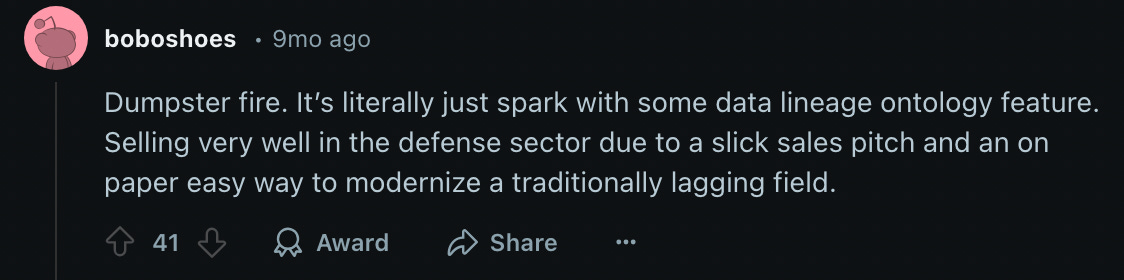
The pattern is clear: data engineering professionals are deeply dissatisfied. The dominant view is that Palantir is sold top-down to non-technical executives and government officials through Peter Thiel’s influence, then forced onto entire organizations.
Excessive Customization: High Cost, High Price, Low Scalability
The “Forward Deployed Engineer” model exists because Palantir’s product requires heavy customization for each client — an engineer must be embedded on-site to make it work. This isn’t a platform that data teams adopt bottom-up after trying it out; it’s chosen by executives and imposed company-wide from the top, which makes Palantir’s engineers essential to the process.
This over-customization also makes uniform updates difficult. They built Apollo to address this, but it remains a hard problem. And if there aren’t enough Forward Deployed Engineers, response times to service requests slow down, forcing continuous headcount growth — driving high costs for Palantir and high prices for customers.
Salesforce went through something similar years ago when they forced all customers onto Lightning. My former portfolio companies had to hire outside consultants and spend months of time and personnel getting through that migration.
Writing all this out, I’m starting to wonder: if this is all true, maybe the bigger risk isn’t Palantir itself but the large enterprises that adopted it. A conspiracy theory materializes: Peter Thiel’s master plan to destabilize legacy corporations so his startups can take their place... 😂
The Valuation Is Absurd
Palantir’s price-to-earnings ratio currently sits at 559. The software sector median is 26. It’s higher than Tesla and virtually every other company. Tesla and Amazon have had even higher PERs during their growth phases, so elevated multiples during rapid scaling aren’t unprecedented — but this only makes sense if you assume Palantir, at $3B in revenue, will smoothly grow into a Magnificent 7-level company. That’s a massive assumption. It’s also worth noting — though not a critical indicator — that company insiders have been consistently selling significant amounts of stock.
Government Customer Risk and Formidable Competitors
Government contracts represent 55% of Palantir’s revenue. That sounds stable, but government deals are politically sensitive, can shift quickly, and tend to arrive in large, lumpy chunks rather than steady streams (SpaceX’s launch business carries the same risk).
The U.S. government also actively avoids vendor lock-in. If Palantir becomes the dominant vendor, competitors with equivalent security clearances — Databricks, Snowflake, Microsoft, IBM — will get opportunities as the government diversifies. That’s a structural headwind for Palantir’s growth.
One more thing: the deeper Palantir’s government ties become — especially with defense — the harder international expansion gets. Foreign companies and governments will have reservations about a platform so closely linked to U.S. defense infrastructure.
But Then Again, Flip It Around
Does It Need the Best AI Tech?
As I’ve written before, having the #1 technology doesn’t automatically make you the #1 company. What matters equally is delivering the best experience to your most important users. If Palantir nails the experience for the executives and decision-makers who actually matter, cutting-edge AI tech might not be necessary.
Engineers Hate It Because It Threatens Their Jobs
Flip the engineer complaints: (1) it’s an unfamiliar platform requiring Forward Deployed Engineers who could replace them, (2) it’s less flexible than what they’re used to, and (3) it empowers business users and executives to do data analysis without them. If Databricks and Snowflake are Android, Palantir might be iPhone.
Top-Down Deployment Creates Massive Switching Costs
Even if it’s not technically superior, once executives have a jaw-dropping demo experience and deploy company-wide from the top, sunk costs and internal politics make switching extremely difficult.
The flip side: this is potentially bad news for the companies that adopted Palantir. If the product underperforms expectations, the companies that publicly announced Palantir deployments could take a hit too. (That’s when you short them and trigger the Palantir Financial Crisis... kidding. Mostly.)
Excessive Customization? Salesforce and NetSuite Grew That Way Too
Every company thinks its business is unique. In reality, most would be better off adapting their processes to fit proven platforms like Salesforce or NetSuite. But internal politics and ego transform good software into Frankenstein monsters of customization. This creates additional consulting revenue and upsell opportunities for the vendor — and makes customer churn progressively harder.
Actually, Not That Bad?
Honestly, the deeper I dug into Palantir for this piece, the more I thought “this isn’t as bad as I expected.” The financials look solid so far, and the company holds up reasonably well against competitors. It’s undeniably one of the most interesting companies to watch.
What Palantir Reveals About B2B AI Right Now
Looking at Palantir, I see the clearest illustration of where B2B/Enterprise AI actually stands: big dreams, long road ahead. Long-term, B2B AI will absolutely create enormous value. But getting there will take longer than people think.
Heavy customization is still required. B2B AI’s potential is massive, but tailoring solutions to each company’s needs still takes more time and money than expected. Companies that can make customization and onboarding faster and simpler will have the biggest advantage going forward.
Costs are too high. Software licensing, cloud costs, and AI compute costs stack up. Prices are coming down, but not fast enough. I’m hoping the Stargate-level data center investments accelerate this.
Consistent accuracy for enterprises remains elusive. This generation of AI can’t eliminate hallucinations, so it can’t guarantee the accuracy levels enterprises demand. Humans will need to stay in the loop, and fully automated task-based pricing remains too risky for now.
The winner will minimize onboarding and lower costs. The company that cracks low-cost, low-friction onboarding with optimized price-performance and offers the kind of scalable, fixed-price structure that traditional SaaS delivers — that company wins B2B AI. It sounds impossible today, but I think AI-automated customization will develop quickly. Combined with falling model costs, performance convergence across models, and open-source proliferation, we could see fixed-cost “SaaS 2.0” — or AaaS (AI as a Service) — within a few years.
And the company that gets there first? That’s your next Big Tech.
Let’s stop getting swept up in FOMO, stop falling for the irresponsible AGI hype from influential people padding their own pockets, and start recognizing the startups that are realistically and fundamentally creating value for customers. I hope we see more founders building those companies — and more customers and investors who can spot them.
Thanks for reading, as always.
— Ian