

One of the most interesting questions I’ve gotten recently:
“If AI is going to handle all the coding anyway, how should startups build moats? Especially for B2C apps — isn’t it nearly impossible to differentiate?”
The founder asking this was worried that since AI can write code, programming and the product itself can no longer serve as a moat. Whatever you build, someone else can build the exact same thing. A fair concern.
Fundamental Value Doesn’t Change in the AI Era
Let me start with the conclusion: powerful moats absolutely still exist in the AI era. And in my view, they haven’t changed much at all. I can’t list every possible moat, but here are the ones that matter most.
Data is still accumulated only through time and user behavior, which makes it inherently defensible — and itself a switching cost. Network effects remain the most powerful moat: value increases exponentially as users grow. Brand and trust are critical moats in B2C tech, consumer products, finance, healthcare, and education — any domain where trust matters. Community and ecosystem — developer ecosystems, partnerships, user communities — create virtuous cycles of customer acquisition and retention that function as durable moats.
But above all else, the ultimate moat is overwhelming consumer experience. A truly great experience drives organic growth through referrals and virality, acquiring new users naturally. Simultaneously, a service that’s deeply embedded in users’ daily lives becomes nearly impossible to replace, creating lock-in — which feeds directly into brand, trust, and community, which in turn build data and network effects. The bottom line: building a genuinely, truly, ridiculously good product is still the answer. It always was.
Sound familiar? Doesn’t seem all that different from the pre-AI era, does it?
So Why Does Everyone Think Speed Is the Moat?
Last month, a16z’s Bryan Kim wrote a piece arguing that “speed” is what matters — launch fast, market fast, update fast. I get the appeal, and I partially agree. But I couldn’t fully buy in.
My theory: many founders find the real moats I described above too hard to build, so they gravitate toward “speed” because it feels more achievable. There’s also a certain appeal to declaring that “the AI era changes everything” — it sounds visionary, like you’re dropping fresh insight. But it’s mostly an illusion.
When Everyone’s Fast, Speed Isn’t a Moat
Here’s the logic: if AI made only your company faster, that would absolutely be a moat. But AI made everyone faster. Some teams might ship updates slightly quicker than others, but that’s no different from the relative speed differences between startups that existed long before AI. “Speed as a moat” is a temporary optical illusion — it looks like a moat compared to the old pace, but it’s not a defensible advantage in today’s landscape where everyone has the same acceleration.
History Proves It: Speed Always Mattered, But Never More Than Now
Speed has always been important — and simultaneously, never the deciding factor.
Notion overtook Evernote as a latecomer by combining great design, flexible extensibility, and fast iteration. Figma vs. Adobe followed a similar pattern. The late entrant won not because of speed alone, but because they built a better experience.
The counterexamples are just as compelling. Instagram’s Stories feature was shamelessly copied from Snapchat — launched much later — and Instagram still has more users. Zoom out further: Google came after Lycos. Facebook came after MySpace. In every case, the faster first mover lost to the better product.
The Monsters That Speed Obsession Creates
This speed fixation has produced some genuinely awful consumer experiences. Some AI apps are piling on features and changing things so frequently that the product becomes a cluttered, disorienting mess.
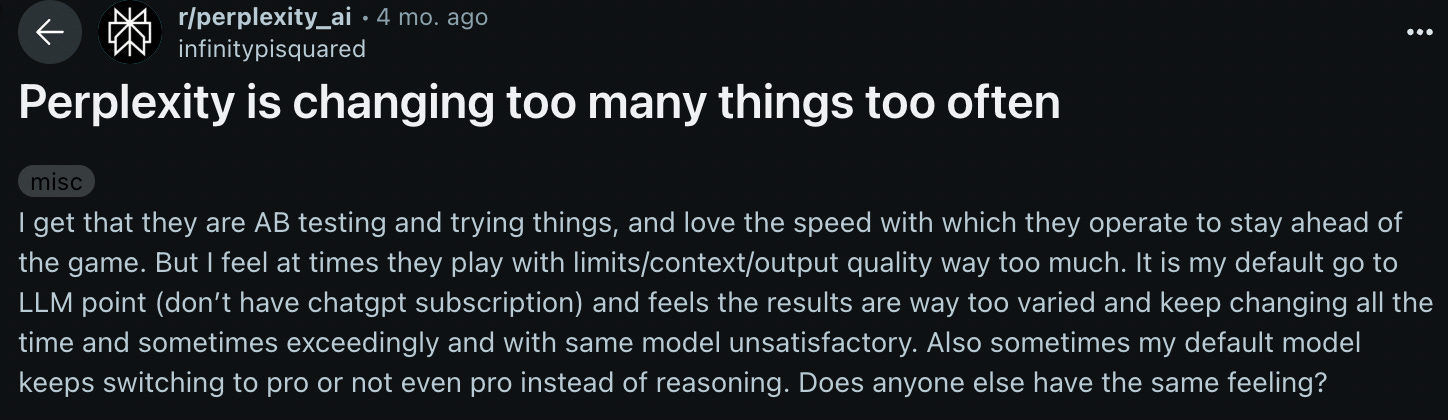
I’ve felt this with Perplexity. They’ve added so many features in pursuit of breadth that feature bloat has set in, while constant changes leave users confused and fatigued. It’s a textbook case of speed obsession degrading consumer experience. When you factor in their cost structure and scalability challenges, I’m genuinely worried about Perplexity’s future.

Will Today’s Speed Translate Into Successful Exits?
On a longer timeline, here’s what I keep asking: can these AI apps that grew at insane speed sustain that growth — or optimize enough to reach an actual exit?
The “acquire users now, lock them in with improving experience later” strategy isn’t worthless. But consumers are less forgiving than people think. They don’t give you many chances, and once they leave, getting them back is extraordinarily difficult. The brute-force approach of constant updates, endless testing, and rapid shipping worked when AI startups still had novelty factor. Now that many companies are using AI well and competition is intensifying, that playbook is running out of runway.
What matters is delivering a sharp, powerful experience from day one, then continuously strengthening that experience — using AI to iterate faster than was previously possible. That’s different from shipping everything and seeing what sticks.
Let’s be clear: how many users a startup acquired, how fast it grew, which prestigious VC invested, how much it raised — these are all just proxies for predicting an exit. A startup that never exits is dust. Many AI companies are showing impressive growth, but it’s premature to draw conclusions.

The blistering growth of AI apps is both a blessing and a curse. The defining characteristic of this era is that user growth drives cost growth at a disproportionately high ratio compared to traditional software businesses. Costs are coming down, and that problem will eventually resolve — but whether companies can (1) survive long enough on external funding and (2) retain users in the meantime is a question no one has answered yet.
One more thing: the historically fast growth of AI apps is genuinely impressive, but honestly, I’m more impressed by the technology and the era than by any specific company. These companies didn’t grow fast because they’re special — they grew fast because the world is at a historic inflection point. Whether any of them will be remembered alongside Google, Meta, or Apple as one of the greatest companies in history? We need a lot more time to know.
Consumer Experience Is the Ultimate Moat
Speed isn’t uniquely important in the AI era. Speed has always been important. But what’s more important than speed is consumer experience — and that fact has never changed and never will.
Design, UI/UX, taste — these are all essential components of building the best consumer experience. A vibe-coded app thrown together quickly cannot beat the long-term compounding of expert-crafted consumer experience. (More on this next week.)
Right now, speed looks like the only thing that matters. But that’s because we’re in the early innings of the AI era — it’s a bubble and an optical illusion. We’ll return to prioritizing consumer experience above all else. The difference is that everyone will be building faster together.
Thanks for reading, as always.
— Ian