

Look, I get it. Every LP meeting, same question: “Ian, isn’t K-Beauty just another fad?”
For years, my answer has been: “It’s the ecosystem.” The supply chain. The ODM/OEM infrastructure. The speed to market. (I wrote about that here; K-Beauty Is Not Gangnam Style. It’s BTS)
And that’s true. Korea has the most efficient beauty supply chain on Earth.
But here’s the deeper question I kept avoiding: Why does Korea have that ecosystem in the first place?
Because ecosystems don’t just appear. They’re built by people. And people are shaped by culture.
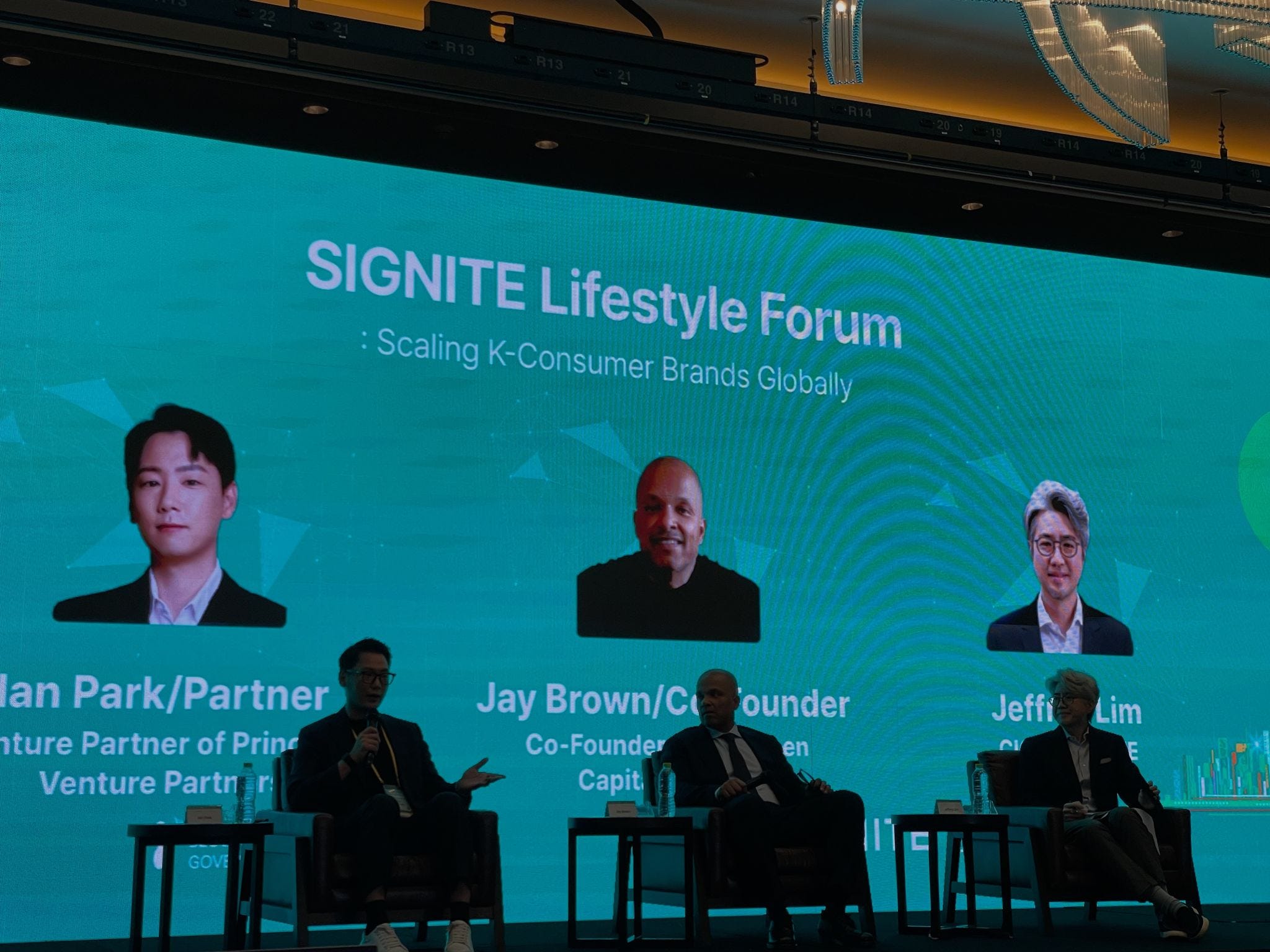
Last week at Seoul Investor Forum’s SIGNITE Lifestyle Forum, I was on a panel about scaling K-consumer brands globally with Jay Brown — co-founder of Roc Nation and Marcy Venture Partners with Jay-Z.
Someone in the audience asked: “Why is K-Beauty succeeding?”
I started giving my usual answer about the ecosystem. Supply chains, ODM/OEM infrastructure, speed to market.
Then I stopped. And told them what I should’ve been saying all along.
The real answer to “Why did K-Beauty win?” isn’t about factories or supply chains.
It’s about a society that can look you in the eye and say, “You look fat.”
In the U.S., that’s an HR violation. In Korea, it’s just another Tuesday.
The Blunt Truth Behind K-Beauty’s Rise
That blunt, appearance-conscious culture? It’s not just rude. It’s what built the most efficient beauty ecosystem on Earth.
When people constantly give and receive feedback about how they look, awareness goes up. Self-care becomes a habit. Experimentation becomes normal. And innovation follows obsession.
That feedback loop — constant awareness → obsession → iteration — is why Seoul became the world’s plastic surgery capital. It’s why Korean skincare routines feel like rituals to outsiders. It’s why the best beauty trends start in Korea.
This isn’t marketing. This is cultural firmware that’s been running for decades.
In America, my golden rule is: “Don’t comment on anything someone can’t change in 30 seconds.” Hair in your teeth? Fine. Weight gain? Absolutely not.
But in Korea, those conversations are normal. “You look tired.” “Your skin’s breaking out.” “Did you gain weight?” Not malicious — just honest.
And that honesty? That’s the root cause of Korea’s beauty dominance.
Why Korea Can Say “You Look FAT” (And Why It Matters)
I used to just answer “ecosystem” when people asked about K-Beauty’s success. But last week, jogging through Seoul, I went one level deeper: Why does Korea even have this ecosystem?
Five reasons:
1. Concern, not criticism.
In Korea, “You’ve gained weight” often translates to “I care about your health” or “I’m paying attention to you.” It’s relationship maintenance, not an attack.
2. Homogeneity breeds comparison.
Korea is (relatively) ethnically homogeneous. Similar beauty standards mean changes are more visible and more discussable. Everyone’s measuring against the same baseline.
3. Extreme competition.
Small country, limited resources. Everything becomes competition — school, jobs, marriage, even appearance. Your weight isn’t just personal; it’s a signal of self-discipline and competitiveness.
4. Appearance as social capital.
Looking good isn’t vanity in Korea — it’s strategy. Better opportunities come from better impressions. So appearance feedback isn’t invasive; it’s socially relevant information.
5. Collectivism over individualism.
Group harmony matters more than individual privacy. Your appearance affects the group’s image. So commenting on it isn’t rude — it’s communal care.
This isn’t about Korean people being “mean” or “shallow.” It’s about a society where self-improvement is a collective sport, and feedback is the scoreboard.
But that pressure? That constant awareness? It’s toxic. And it’s also what makes Korea the world’s R&D lab for beauty innovation.
The Beauty — and the Burden — of Perfection
K-Beauty’s rise didn’t happen in a vacuum. It came from a country that also ranks among the highest in the OECD for suicide rates, especially among young people.
That statistic isn’t a footnote. It’s part of the same story.
When a society rewards achievement and appearance more than rest or failure, you get two outcomes: unbelievable excellence — and unbearable pressure.
K-Beauty isn’t a feel-good story. It’s what happens when a society turns anxiety into a competitive advantage.
That’s impressive. That’s also deeply fucked up.
The same drive that makes Korea out-innovate everyone in skincare also burns people out faster than anywhere else. The relentless “try harder, look better, never stop” mentality powers an ecosystem that can beat anyone — but at what cost?
If you admire the speed and quality of Korean brands, also recognize the human cost behind them. The next generation’s mission isn’t just to sell better products — it’s to build systems that don’t destroy the people creating them.
So What’s the Thesis?
Here’s what most people miss when they ask “Is K-Beauty sustainable?”: It’s not about whether people keep buying sheet masks. It’s about whether the cultural infrastructure that produces this behavior is stable.
And that infrastructure — the feedback culture, the competition, the collectivism, the 50-year supply chain — has been getting stronger, not weaker.
K-Beauty isn’t a product line. It’s the export of a national operating system for self-improvement. K-Pop and TikTok were just catalysts. The ecosystem was already there, rowing hard. This time, the tide finally came in.
So the question isn’t whether K-Beauty is a fad. It’s: What else can this system produce? Supplements? Functional foods? Longevity?
And here’s where it gets interesting: systems built on anxiety eventually eat themselves.
K-Beauty 1.0 was about perfection at any cost. Now Koreans are asking: What was the cost? Burnout. Mental health crises. A generation saying “I’m tired.”
That’s why wellness is exploding in Korea right now — not surface-level “self-care Sunday” wellness, but the kind that asks whether optimization is worth destroying yourself.
Look at what’s trending: SMCC (Seoul Morning Coffee Club) — morning coffee raves at 6 AM instead of Itaewon parties until 4 AM. Positive Hotel — spaces designed to let you rest, not optimize.
If Korea can export the pressure, maybe it can also export the antidote.
The infrastructure is there. The cultural literacy is there. The innovation engine is there. Now it just needs to point in a different direction.
That’s the K-Beauty I’m excited about — not the one that perfected anxiety as a business model, but the one that’s learning to live without it.
Thanks for reading,
Ian
(Rumor has it this whole essay started because my mom told me I looked fat during Korean Thanksgiving. So… thanks, Mom.)
Founders building in K-Wellness, K-Mental Health, K-Longevity: ian@ianpark.vc Especially if you’re working on the antidote.